
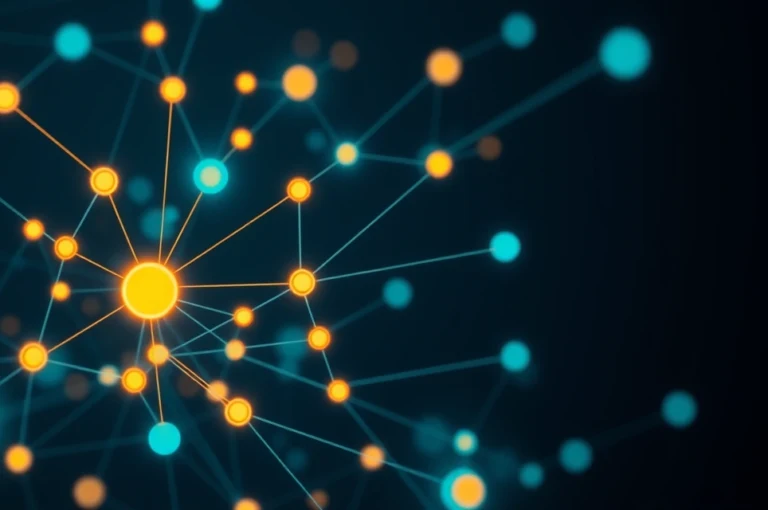
An Entity Graph is the semantic backbone that allows search engines, AI systems, and content frameworks to interpret meaning beyond words. It is a data structure that represents the relationships between entities, people, places, brands, or abstract ideas, forming a connected network of meaning rather than a list of disconnected keywords.
Unlike traditional SEO approaches focused on backlinks or keyword density, an entity-centric structure values semantic relevance, topical authority, and knowledge-based trust. This shift transforms how search engines read and evaluate content, making the entity graph a crucial layer of the modern semantic content network.
Entity Graph vs Knowledge Graph
An entity graph is often confused with a knowledge graph, but the distinction lies in focus and scope. A knowledge graph represents factual relationships curated from structured databases like Wikidata or Google’s internal systems.
An entity graph, however, can be built dynamically from unstructured sources, such as web pages, images, or social mentions, by identifying entities through named entity recognition and mapping how they co-occur or interact.
At its core, the entity graph is a model of context:
Nodes
represent distinct entities (e.g., “Apple”, “iPhone”, “Steve Jobs”).
Edges
represent relationships (e.g., “Apple → produced → iPhone”).
Weights and directions
express the strength and orientation of these relationships.
This graph acts as a contextual mirror of real-world knowledge. When embedded into your content strategy, it connects your topics through meaning, not just hyperlinks, enhancing semantic similarity and supporting deeper query optimization.
[dflip id=”20300″][/dflip]
Core Components and Mechanics
1. Nodes (Entities)
Each node within the graph represents a unique concept or entity. These entities may be explicitly mentioned (e.g., “Google”) or implicitly inferred through context. Using NLP pipelines, search engines extract and normalize these entities, ensuring they correspond to canonical identifiers in systems like Wikidata.
In SEO, identifying and tagging entities correctly aligns with strong structured data practices, allowing your website to function as a verified component of the web’s knowledge infrastructure. Each node contributes to your site’s topical authority, positioning it as a trusted entity within a topic cluster.
2. Edges (Relationships)
Edges connect two nodes and describe their relationship. This can be hierarchical (“Tesla → founder → Elon Musk”), associative (“Apple → competitor → Samsung”), or contextual (“ChatGPT → trained on → Wikipedia”).
Relationships are weighted through Pointwise Mutual Information (PMI) or graph-embedding scores, expressing how strongly two entities are related.
When multiple entities frequently co-occur within similar contexts, their semantic bond strengthens. This mechanism mirrors how Google’s passage ranking isolates and ranks meaningful sections within long-form content.
3. Graph Properties and Contextual Flow
Every entity connection exists within a broader semantic flow. Maintaining logical relationships between entities ensures smooth contextual flow, a principle that helps both users and crawlers navigate information naturally.
When you connect related nodes across your content network using contextually relevant internal links, you form a mini-entity graph within your domain. This not only reinforces meaning but also supports efficient crawling, reducing orphaned or semantically isolated pages.
4. Graph Pipeline and Construction
Building an entity graph follows a structured pipeline:
Entity Extraction
detect entities via NER and relation extraction.
Entity Resolution
merge duplicates or variants (e.g., “NYC” = “New York City”).
Relationship Inference
establish co-occurrence or semantic proximity between entities.
Graph Storage & Maintenance
store in a vector or graph database for scalable access.
This process supports not only SEO but also data-driven content automation, recommendation systems, and semantic indexing.
Why Entity Graphs Matter for SEO and Content Strategy?
The modern search ecosystem has shifted from strings to things, and entity graphs are the reason behind it. Google, Bing, and emerging AI search systems evaluate how well your content aligns with entities and their connections, not merely how many times you repeat a keyword.
1. Enhancing Semantic Relevance
An entity graph enables search engines to interpret relationships between your topics. By clearly mapping how your pages relate through entities, you strengthen semantic relevance. This makes it easier for algorithms to infer meaning, improving how your pages rank for intent-driven queries.
2. Supporting Topical Clusters and Authority
Each node in your site’s internal graph contributes to a broader topical map, a hierarchical structure that demonstrates subject expertise. By linking semantically adjacent content (e.g., Entity Graph → Knowledge Graph → Topical Authority), you form a contextual bridge between related entities. This enhances both crawlability and user understanding.
3. Entity-First Content Design
Entity-driven SEO redefines content planning. Instead of starting with keywords, start with entities: who, what, where, and how they connect. Tools that extract entities from top-ranking pages can reveal your competitive entity landscape. Integrating this insight ensures your content architecture mirrors how search engines conceptualize information, anchored by relevance, trust, and update score freshness signals.
4. Improving Knowledge Integration
Entity graphs make it possible for your brand or website to become part of a larger web of knowledge. When your structured data consistently identifies the same entities across pages, you reinforce your position within the global knowledge graph. This alignment enhances visibility in rich snippets, search result snippets, and AI-driven summaries.
Applications of Entity Graphs Beyond SEO
The power of an Entity Graph extends far beyond SEO, it serves as a foundation for information retrieval, artificial intelligence, and real-time reasoning systems. By mapping contextual meaning, these graphs enable machines to interpret, connect, and predict relationships between ideas, people, and digital assets.
1. Information Retrieval and Semantic Search
Entity graphs drive the evolution of information retrieval systems from simple keyword matchers to semantic retrieval engines. Search models like DPR (Dense Passage Retriever) and BM25 increasingly rely on entity-aware embeddings to connect documents through meaning rather than text overlap.
When paired with query rewriting or query augmentation, entity graphs help systems map diverse search queries to the same conceptual entity. This ensures consistent retrieval, even when users express intent differently.
By integrating both dense (contextual) and sparse (lexical) retrieval techniques, an entity graph supports hybrid ranking models that combine precision with depth, bridging classical IR with AI-driven search.
2. Artificial Intelligence and Machine Learning
Entity graphs play a critical role in knowledge-grounded AI. Large language models like GPT and PaLM increasingly rely on graph-like structures during pretraining and retrieval phases.
These graphs allow systems to:
Ground responses in factual entity relationships.
Perform entity disambiguation, linking ambiguous terms to their correct referents.
Leverage graph embeddings and neural reasoning, enabling models to infer unseen relationships between entities.
Recent advances in knowledge graph embeddings (KGE) and Graph Neural Networks (GNNs) illustrate how structured entity connections enhance semantic understanding. When integrated with vector databases and semantic indexing, these representations enable real-time entity lookup and reasoning in AI assistants, recommendation systems, and conversational search.
3. Recommendation Engines and Personalization
Entity graphs also support personalization and content discovery. By identifying relationships between entities like topics, authors, or user interests, they allow for dynamic content recommendation, similar to how passage ranking improves content retrieval.
In marketing systems, entity graphs map brand mentions, product reviews, and user behaviors, transforming unstructured feedback into meaningful connections. This model empowers context-aware personalization, ensuring users receive relevant experiences across every digital touchpoint.
Advantages, Limitations, and Best Practices
Advantages of Using Entity Graphs
Semantic Precision:
Helps search engines understand contextual meaning rather than keyword frequency.
Enhanced Crawlability:
Interlinks your node documents in a logical graph, improving discovery and link equity distribution.
Topical Authority Reinforcement:
Establishes your site as an entity hub around core subjects.
Future-Proof Content Architecture:
Enables adaptability to AI-generated summaries and entity-driven search results.
Entity graphs also align with Google’s evolution toward E-E-A-T and semantic evaluation. Rather than relying solely on backlinks, Google assesses content through entity-level connections and knowledge-based trust, measuring credibility through verified relationships and contextual accuracy.
Limitations and Challenges
Despite their potential, entity graphs pose challenges:
Complexity in Construction:
Requires consistent structured data and advanced NLP models.
Data Sparsity and Noise:
Incomplete or unverified entity mentions can weaken graph precision.
Scalability:
Large-scale entity graphs demand efficient storage and high computational power for updates.
Entity Drift:
Changes in meaning or context over time (semantic drift) can alter relationships between entities.
To mitigate these issues, regular graph updates, guided by a strong update score framework, ensure entities remain fresh, relevant, and correctly connected.
Best Practices for Building an Entity Graph
Define Your Canonical Entities:
Identify key brand, topic, and product entities early.
Use Consistent Schema Markup:
Apply Schema.org structured data for Organization, Person, and Product types.
Leverage Contextual Linking:
Connect content pieces through semantically rich anchors, maintaining natural contextual flow.
Monitor Entity Relationships:
Use analytics and entity recognition tools to ensure relationships remain accurate.
Integrate with Vector Search:
Combine graph-based reasoning with embedding models for hybrid semantic retrieval.
Future Outlook: Entity Graphs in AI Search
Search engines are increasingly fusing entity graphs with neural embeddings, a convergence that powers modern systems like Google’s Multitask Unified Model (MUM) and Search Generative Experience (SGE).
In this new search paradigm:
Entities are the new index units.
Search algorithms no longer look for text matches but for entity connections.
Topical clusters replace keyword silos.
Websites are evaluated based on the breadth and depth of entity relationships, a direct measure of their topical map and authority.
AI assistants use graph grounding.
Conversational agents leverage entity graphs to ensure factual accuracy and contextual continuity.
Looking ahead, we can expect entity graphs to merge with multimodal data, integrating video, audio, and real-world signals, forming knowledge ecosystems that mirror human cognition. Brands that structure their content as an interlinked entity network will naturally align with the semantic web’s evolution.
Last Thoughts on Entity Graphs
Key Takeaways
- An entity graph maps relationships between entities to form a network of meaning, shifting SEO from strings to things.
- It differs from a knowledge graph by building dynamically from unstructured sources, while a knowledge graph curates verified facts from structured databases.
- Nodes are entities and edges are weighted, directional relationships, so the graph captures both what entities are and how strongly they connect.
- Construction runs through extraction, resolution, relationship inference, and storage, which also powers content automation and semantic indexing.
- For SEO, entity graphs strengthen semantic relevance, reinforce topical clusters, and help a site become part of the wider knowledge graph.
- Maintaining the graph means defining canonical entities, applying consistent schema, linking contextually, and updating often to counter entity drift.
An Entity Graph is not just a data model; it’s the cognitive framework that underpins how search engines, AI models, and content ecosystems understand meaning.
By strategically mapping your content through entities, and maintaining semantic relationships between them, you create a context-aware web presence that resonates with both machines and people. For modern SEO professionals, adopting entity graphs means moving beyond links and keywords toward trust, structure, and semantic clarity, the pillars of future search visibility.
Frequently Asked Questions (FAQs)
What’s the difference between an Entity Graph and a Knowledge Graph?
A knowledge graph is a formal, structured dataset that connects verified facts. An entity graph, on the other hand, can emerge dynamically from unstructured data, mapping relationships inferred from language and co-occurrence.
How can websites implement entity graphs?
Start by mapping entities across your root documents and linking them through meaningful anchors. Use schema markup and consistent entity mentions to help search engines connect your pages semantically.
Do entity graphs replace keyword SEO?
No. They complement it. Keywords reveal query intent, while entity graphs clarify meaning and context. Together, they improve retrieval precision and ranking trust.
Are entity graphs only for large enterprises?
Not at all. Even small websites can build micro-graphs by linking content around well-defined entities. This approach strengthens topical relevance and internal link structure.
How often should entity graphs be updated?
Regularly update your content entities based on new data, trends, or schema changes. Monitoring your update score ensures the graph remains aligned with current search context.
What is an entity graph?
An entity graph is a data structure that represents the relationships between entities such as people, places, brands, or ideas. It forms a connected network of meaning rather than a list of disconnected keywords, which lets search engines and AI systems interpret context beyond words. It acts as a contextual mirror of real-world knowledge.
What are nodes and edges in an entity graph?
Nodes represent distinct entities, for example Apple, iPhone, or Steve Jobs. Edges represent the relationships between those nodes, such as Apple produced iPhone, and they carry weights and direction to express how strong and oriented each relationship is. Together nodes and edges turn separate concepts into a connected model of context.
What are the steps in building an entity graph?
Construction follows a pipeline of entity extraction, entity resolution, relationship inference, and graph storage and maintenance. Extraction detects entities through named entity recognition, resolution merges variants such as NYC and New York City, and inference establishes co-occurrence between entities. The result is stored in a vector or graph database for scalable access.
How are relationship strengths measured between entities?
Relationships are weighted using methods such as Pointwise Mutual Information or graph-embedding scores. These express how strongly two entities are related, and the bond strengthens when entities frequently co-occur in similar contexts. This mirrors how passage ranking isolates and scores meaningful sections within long content.
What are the main limitations of entity graphs?
Entity graphs are complex to build because they need consistent structured data and advanced NLP models. They can suffer from data sparsity and noise when entity mentions are incomplete or unverified, and large graphs demand heavy storage and computation. Entity drift, where meaning changes over time, can also alter relationships, so regular updates are needed.
How do entity graphs support AI and machine learning?
Entity graphs help ground model responses in factual entity relationships and support entity disambiguation, which links ambiguous terms to the correct referent. Techniques such as knowledge graph embeddings and Graph Neural Networks let models infer unseen relationships between entities. Paired with vector databases, these structures enable real-time entity lookup and reasoning in assistants and recommendation systems.
Want to Go Deeper into SEO?
Explore more from my SEO knowledge base:
▪️ SEO & Content Marketing Hub — Learn how content builds authority and visibility
▪️ Search Engine Semantics Hub — A resource on entities, meaning, and search intent
▪️ Join My SEO Academy — Step-by-step guidance for beginners to advanced learners
Whether you’re learning, growing, or scaling, you’ll find everything you need to build real SEO skills.
Feeling stuck with your SEO strategy?
If you’re unclear on next steps, I’m offering a free one-on-one audit session to help and let’s get you moving forward.
Download My Local SEO Books Now!

Table of Contents
Toggle