HMB Pottery - Client Case Study

Client Case Study
HMB Pottery
Handmade Multani blue pottery, sold online at multaniblueart.com
The Client
HMB Pottery makes handmade Multani blue pottery: dinner sets, tea sets, mugs and decor pieces, each hand-painted and glazed in Multan. The craft is centuries old, but the business needed a shopfront that could reach buyers beyond the local market and carry the story behind every piece.
The Challenge
Handmade pottery is difficult to sell online. Buyers cannot hold the piece, colour and finish vary between items by design, and shipping fragile ceramics needs to be addressed before someone will commit. The brand also had to look credible next to mass-produced tableware without hiding what makes it different.
What We Built
- A WooCommerce store covering the full catalogue: dinner sets, tea sets, mugs, cake stands and dry-fruit sets
- Product pages that show the handmade detail properly, with photography that reads at thumbnail size
- Quality and care messaging built into the design: permanent glaze colour, oven safe, handmade production
- Google reviews surfaced on the storefront as social proof
- Search-ready structure so the catalogue can rank for pottery and tableware queries
The Result
A live storefront that sells the craft rather than just listing products, carrying the brand mission of making HMB Pottery a symbol of South Asian craftsmanship found in homes and designer spaces worldwide.
The SEO Strategy
Building the store was half the job. The other half was making sure it could be found, which ran on four tracks at once.
Domain and technical foundation
A domain that states what the business sells, and the technical groundwork underneath it: crawlable structure, clean titles and descriptions, correct product markup, and a site fast enough to hold a shopper who arrived from a search result.
On-page and content
Individual pages for each category and product family rather than one catalogue page carrying everything. Each targets its own query set, from the broad terms down to the specific multi-word phrases a buyer uses when they already know what they want.
Local and profile signals
Google Business Profile optimised, consistent citations, and reviews surfaced where buyers see them. For a craft business the local signal does double duty: it proves the workshop is real and it anchors the origin story that the product depends on.
Authority building
Supporting content around the craft, the material and the care of it, each piece linking inward to the products it relates to. That is what turns a catalogue into something search engines read as a subject authority rather than a list of items for sale.
Results in Search Console
Two consecutive twelve-month windows, so the second picks up where the first ends. Impressions grew from 428K to 640K and average position improved from 9.8 to 6.2.
Twelve months to September 2025
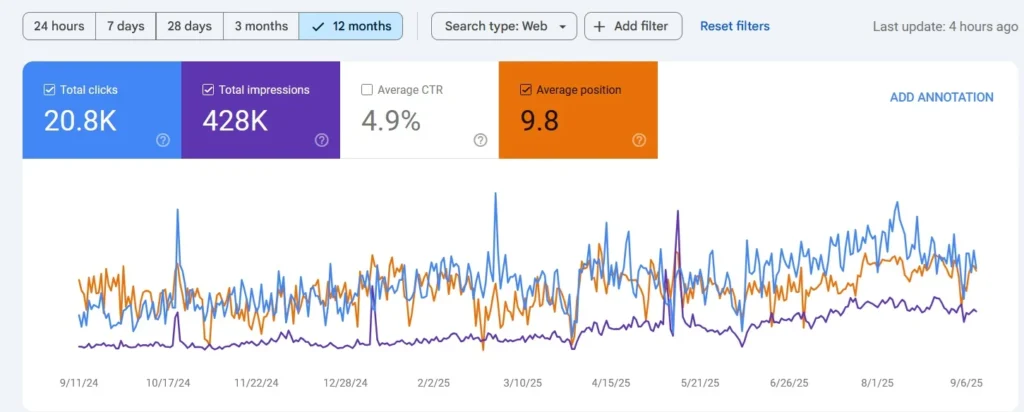
20.8K clicks, 428K impressions, 4.9% CTR, average position 9.8.
Twelve months to August 2026
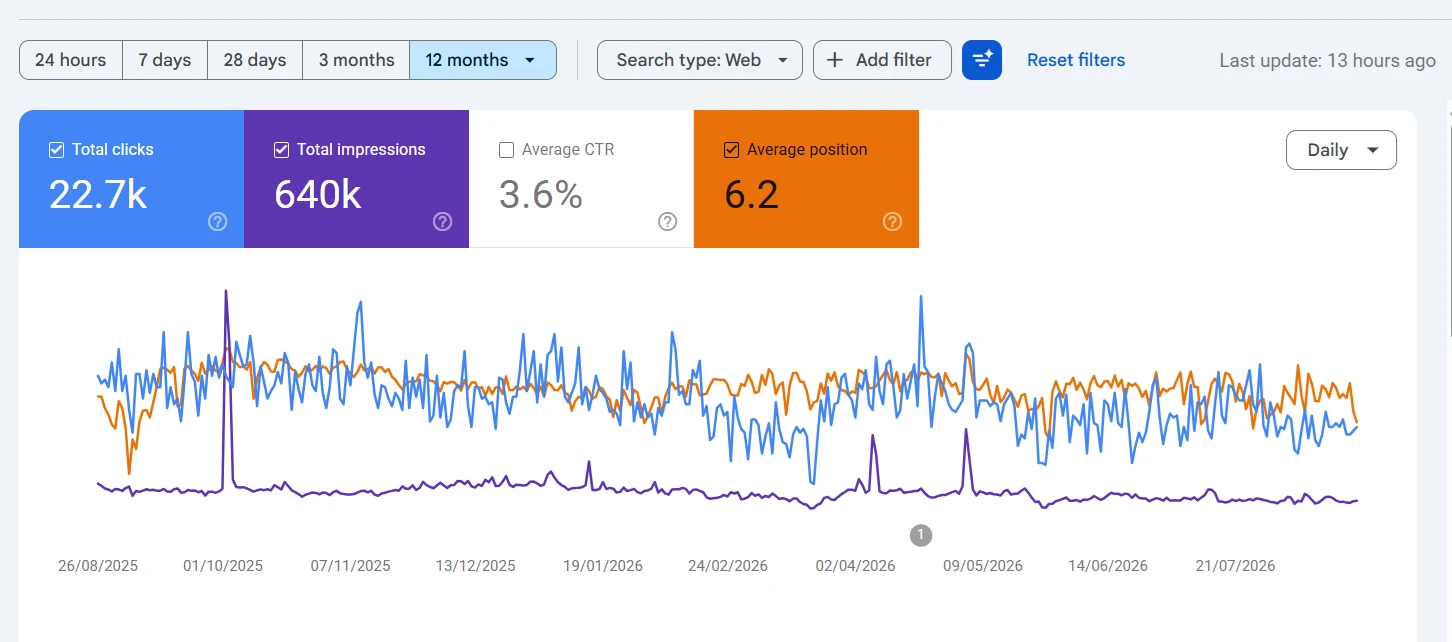
22.7K clicks, 640K impressions, 3.6% CTR, average position 6.2.
Average position moving from 9.8 to 6.2 is the meaningful shift here: the catalogue went from the foot of page one to the middle of it across a broad set of queries. Impressions rose by half again over the same span. Click-through settled from 4.9% to 3.6% because the extra reach came from a wider and more general query mix, where fewer searchers click any single result.
Traffic in Google Analytics
The same period seen from the analytics side, measured against the previous period and against the peer benchmark for the Ceramics and Pottery category.

1 January to 24 August 2026, compared with the preceding period.
Active users more than doubled against the previous period, and the store tracked consistently above the peer median for its category through most of the year. One caveat worth stating: key events are recording zero, which means conversion tracking is not yet configured on the property. These are audience and engagement figures, not sales figures, and setting up proper e-commerce conversion tracking is the obvious next step.
Thirty Days of Real-Time Traffic
A screen recording of live organic traffic across a thirty-day window, so the numbers above can be watched arriving rather than read off a summary.