My name Is Nizam, and I am a...

Shopify SEO Services!

Shopify made the store easy to launch and hard to rank. Wondering why your products exist at three different URLs and your speed score will not move?

I specialise in SEO for Shopify stores. Shopify is an excellent commerce platform and a genuinely awkward SEO platform, and most of the problems on a Shopify store are not mistakes the owner made. They are defaults.

What I do for Shopify stores:

  • Fix the duplicate URL problem Shopify creates by default, where one product lives at several addresses and splits its own ranking signals
  • Bring tag and filter pages under control before they bury your real collections
  • Rebuild collection pages so they can rank, rather than being product grids with a heading
  • Cut the theme and app weight that keeps Core Web Vitals red no matter what you compress
  • Work within the platform’s hard limits, and tell you plainly which ones cannot be moved
No fluff. No over-optimisation. Just the platform-level fixes that let a Shopify store rank on merit. Book a free store audit and I will show you how many duplicate URLs your store is currently generating.
Roofing Contractors Industry SEO Services Provider!

Featured!

Endorsed by Top-Tier Publications!

Fix What Shopify Gets Wrong Before You Spend Anything on Content!

Almost every Shopify store has the same handful of problems, because almost every Shopify store inherits them from the platform rather than creating them. The most expensive one is duplication: the same product reachable through a collection path and through its own canonical path, plus tag pages, plus filtered views, all generated automatically.

That is exactly what my Shopify SEO service is built to fix.

The result of leaving it alone is a store that looks fine to its owner and reads as chaos to a search engine: crawl budget spent on tag pages, ranking signals split across duplicate addresses, and new products taking weeks to appear. Content will not fix that. Structure will.

Dominate Local Searches & Get More Roofing Contractors Customers!

Proof of Performance

Case Studies

Real data from real clients. No fluff, just measurable results.

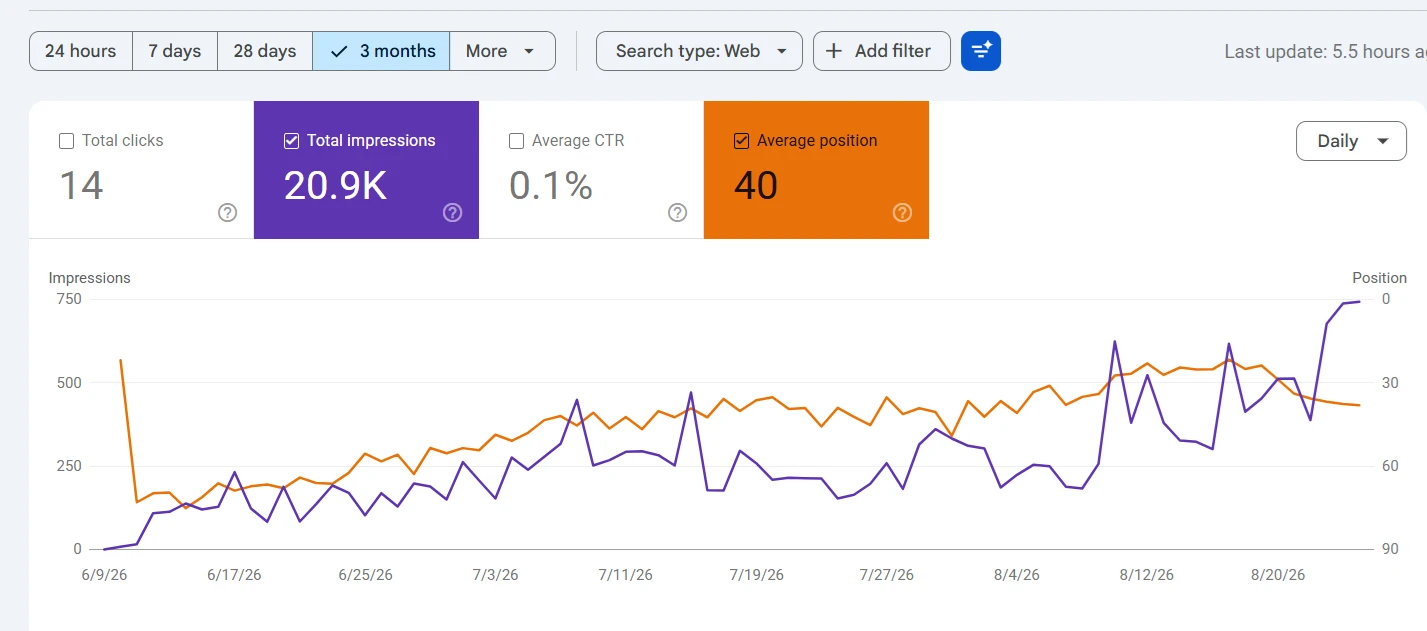
9.61K to 20.9K Impressions, Month Two to Month Three

Newly Launched Roofing Website - Three Month SEO Stats

A brand-new roofing site with no history. Its first two months reached 9.61K impressions at an average position of 49.1. By the end of month three that had more than doubled to 20.9K impressions and the average position had improved to 40. Clicks are still small at 14, which is normal this early: a new domain earns visibility before it earns the top-of-page positions that produce clicks.

20.9KImpressions, from 9.61K
14Clicks, from 7
40Avg. Position, from 49.1
2.2xImpression Growth

See the full project

roofing website Search Console three month impressions and position growth

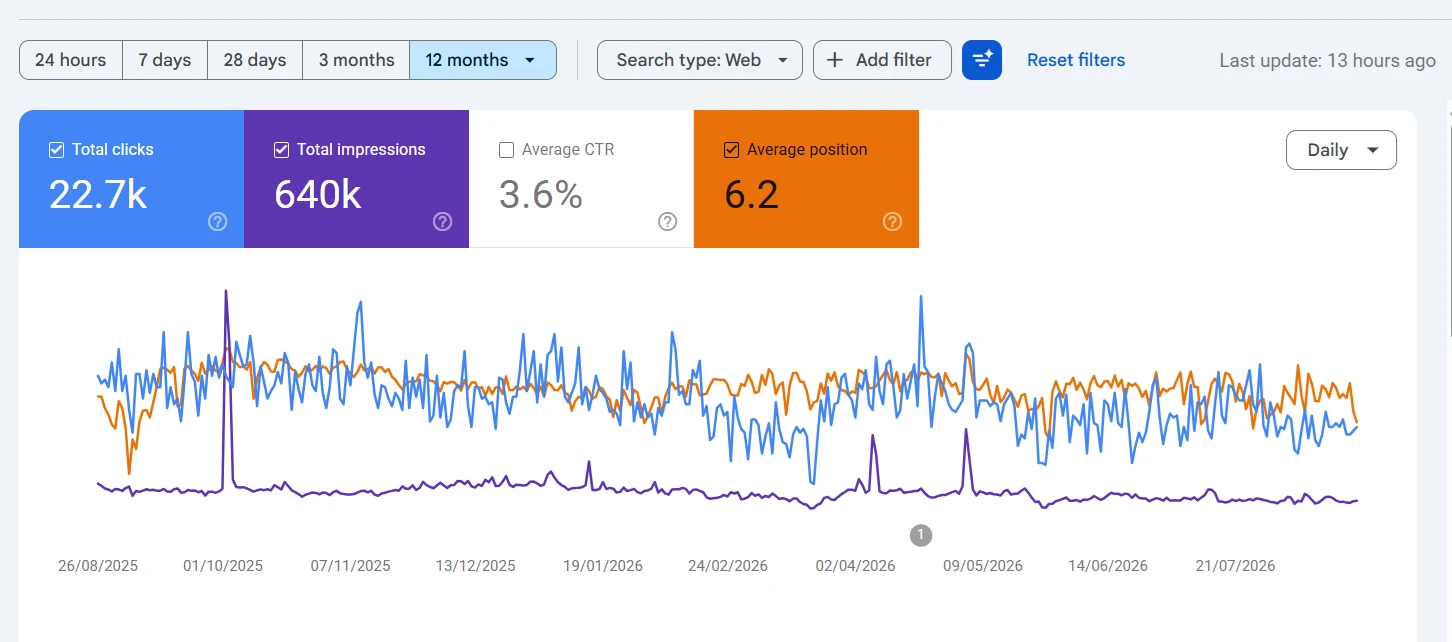
428K to 640K Impressions, Year on Year

Two Years of Organic Growth in Search Console

Two consecutive twelve-month windows for an online store. The first closed at 428K impressions and an average position of 9.8. The second reached 640K impressions with average position improved to 6.2, moving the catalogue from the foot of page one to the middle of it across a broad set of queries.

640KImpressions, from 428K
22.7KClicks, from 20.8K
6.2Avg. Position, from 9.8
+50%Impression Growth

See the full project

Search Console twelve month clicks and impressions growth

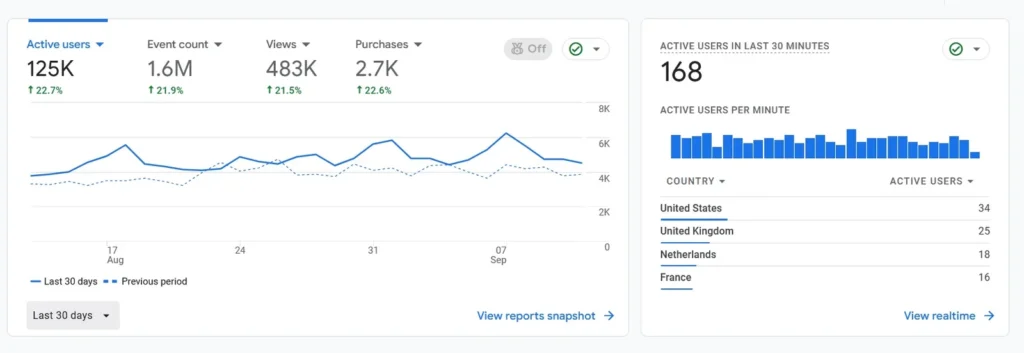
Every Store Metric Up ~22% in 30 Days

E-commerce Store, 30-Day Analytics Snapshot

A 30-day window for an online store selling into the US, UK, Netherlands and France. Active users, product views and completed purchases all rose by roughly a fifth against the previous period, so the extra traffic converted rather than just inflating sessions.

125KActive Users
483KProduct Views
2.7KPurchases
+22.6%Purchase Growth

See the full project

Google Analytics 30 day ecommerce users views and purchases

Flat for Nine Months, Then 732K Impressions

Topical Coverage Build for a Local Restaurant

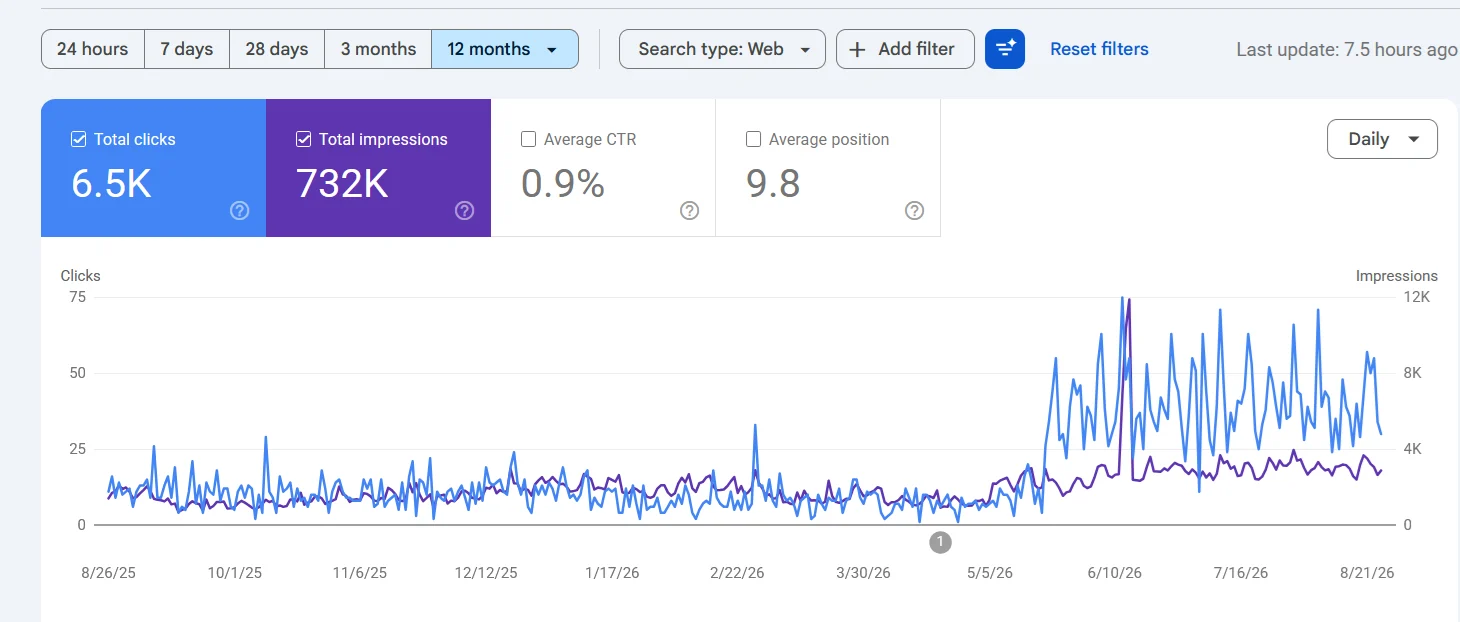
Twelve months of Search Console for a single-location pizzeria. The first nine months sit flat: the site was there, it just did not cover enough of what people were searching for. Once the topical build landed in late May the impression line steps up and stays up, closing the year at 732K impressions and 6.5K clicks. Nothing about the business changed. The coverage did.

732KImpressions, 12 Months
6.5KClicks
9.8Avg. Position
Late MayWhere It Turns

See the full project

Search Console twelve month impressions step change after a topical coverage build

Same Reach, More Than Double the Click-Through

A Restaurant That Ranked and Was Not Clicked

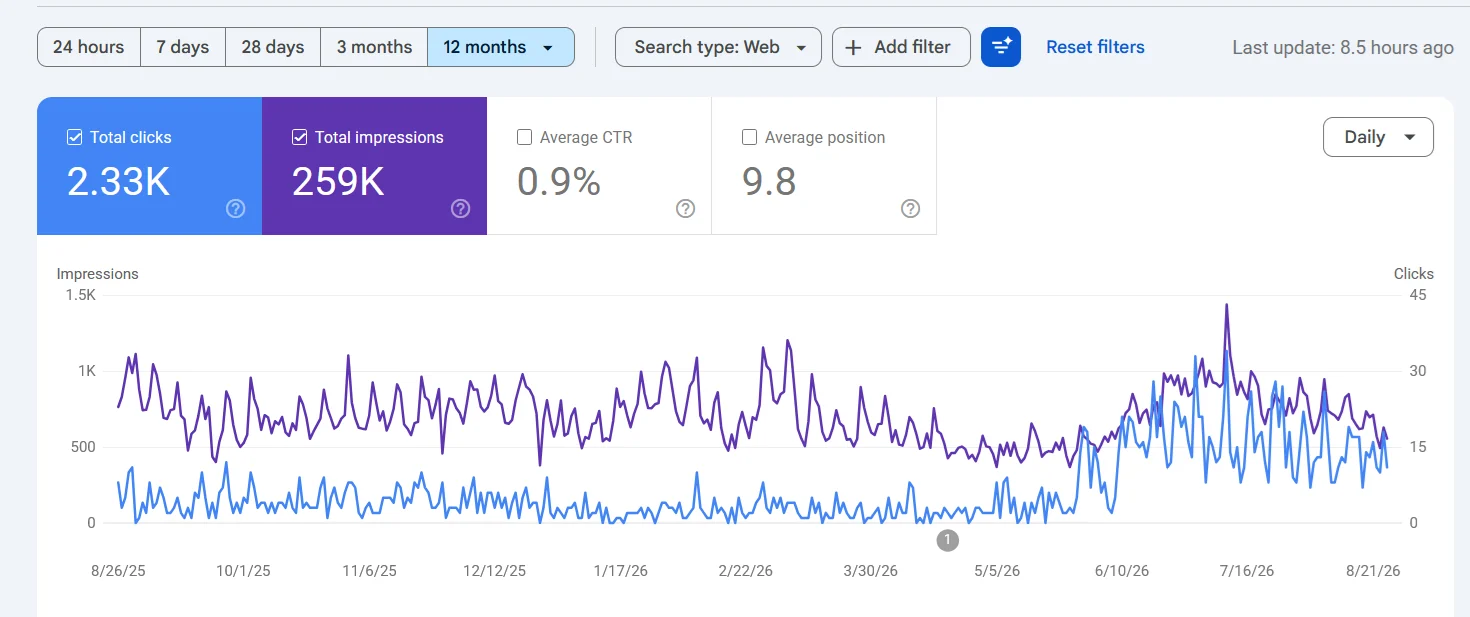
This site was already on page one and taking 64,923 impressions a quarter for 251 clicks, a click-through rate of 0.39%. The rankings were fine. The search snippets were not: 61 pages had no meta description and 62 had titles too long to survive the results page. Fixing what searchers actually see lifted the twelve-month average to 0.9% on the same impression base.

0.9%CTR, from 0.39%
2.33KClicks, 12 Months
259KImpressions
9.8Avg. Position

See the full project

Search Console twelve months with flat impressions and rising clicks

11.1K to 182K Impressions in a Year

Local SEO Build, Two Six-Month Windows Compared

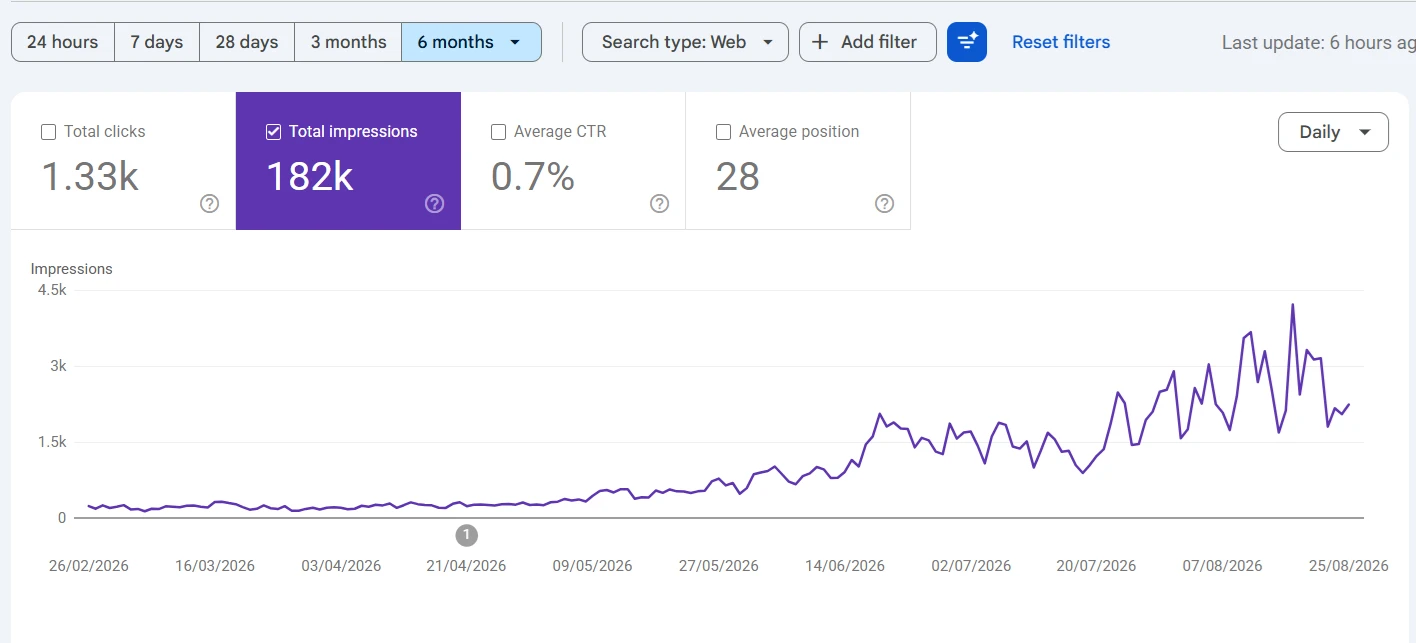
A local cleaning business starting from near-zero visibility. The first six months moved it to 11.1K impressions at an average position of 46.5. The six months after that took it to 182K impressions and position 28. Click-through fell from 4.2% to 0.7% along the way, which is what happens when a site starts surfacing for many more queries before it ranks high on them: the reach arrives first, the positions follow.

182KImpressions, from 11.1K
1.33KClicks, from 471
28Avg. Position, from 46.5
16xImpression Growth

See the full project

Search Console six month impressions growth for a local cleaning business

What changes when the platform-level problems are dealt with first

Most Shopify SEO advice starts with keywords and blog posts. On a store with duplicate URLs and thousands of crawlable tag pages, that is money spent on a foundation that cannot hold it.

With the platform handled properly, you will:

  • Consolidate ranking signals onto one URL per product instead of splitting them across collection paths, tag pages and filtered views
  • Recover crawl budget currently being spent on pages that can never earn a sale
  • Turn collection pages into landing pages that can rank for the category terms buyers use
  • Get new products indexed in days rather than weeks
  • Improve Core Web Vitals by removing app and theme weight, which is almost always the real cause on Shopify rather than image size
  • Earn rich results with product markup that matches the page, including price and stock
  • Use the platform’s international features properly instead of fighting them

The promise: a Shopify store that competes on merit, not on defaults.

Store SEO done this way is measurable in revenue. On one client store the same structural approach produced 1.9 million active users and 50,000 purchases across twelve months, and on another it moved Search Console impressions from 428K to 640K year on year.

My Shopify SEO Framework!

(Platform First, Then Pages, Then Growth)

I fix Shopify stores in a deliberate order, because doing it the other way round wastes money. Structure and crawl, then the pages that sell, then the content and expansion that compound on top of them.

Working inside a hosted platform also means being honest about its limits. Some things cannot be changed on Shopify without Plus, and some cannot be changed at all. I will tell you which is which rather than quietly failing to deliver them.

What you get, end to end:

  • Duplicate URL and canonical resolution across the whole catalogue
  • Tag, filter and collection control so crawl budget reaches your products
  • Collection and product page optimisation for ranking and conversion
  • Theme and app performance work targeted at Core Web Vitals
  • Reporting tied to revenue and purchases, not to keyword counts

How Do My SEO Policies Keep Your Shopify Store Penalty-Safe?

Shopify stores rarely earn a penalty through aggressive tactics. They accumulate quality problems automatically: thin tag pages, duplicate collection URLs, near-identical variant pages and supplier descriptions shared with every other stockist.

My policies are white-hat throughout, and on Shopify most of the work is careful removal.

My compliance-first guardrails include:

  • No link schemes, paid networks or manufactured anchor text
  • No auto-generated collections built purely to target keywords with no real stock
  • Duplicate control across variants, tags and collection paths
  • Index discipline, so the pages Google holds are the ones that can convert
  • Product copy written for buyers rather than pulled from a supplier feed

Result: growth that survives core updates, on a store carrying no hidden risk.

How Do I Fix Shopify's Duplicate URL Problem?

This is the defining technical issue of the platform and the one most stores never notice. Shopify will happily serve the same product through a collection path and through its own product path, and both are crawlable. Add tag pages and filtered views and a modest catalogue can generate many times its real size in URLs.

The consequence is that a product competes against itself, and the crawler spends its budget discovering the same items repeatedly.

Duplicate resolution work includes:

  • A full crawl to establish how many URLs the store is genuinely exposing
  • Canonical strategy so every product consolidates onto one address
  • Internal linking corrected to point at the canonical path, since links usually cause the split
  • A rule for every tag and filter: index it, canonicalise it, or block it
  • Verification in Search Console that the consolidation actually took effect

How Do I Use Keyword Research to Attract More Buyers?

Keyword research on a store is not a list. It is a mapping exercise: which existing page should own which search, and where a page needs to exist that does not yet.

My keyword research method includes:

  • Mapping demand to collection pages first, since they carry the most ranking potential
  • Product-level research for the items where margin justifies the work
  • Identifying collections worth creating because demand exists for them
  • Cannibalisation checks, which matter more on Shopify because tags create competitors
  • Competitor gap analysis against marketplaces and the larger stores in your niche

How Do I Optimise Shopify Product Pages to Rank and Convert?

Shopify product templates are built for conversion and not for search, which is the right default and an incomplete one. The typical page has good imagery, a buy button and a description supplied by the manufacturer that every competitor also uses.

Product page work includes:

  • Original descriptions answering what buyers actually ask before ordering
  • Variant handling so sizes and colourways consolidate rather than splitting signals
  • Titles and meta descriptions built for click-through rather than left as the product name
  • Image SEO: descriptive filenames, alt text and delivery that does not stall the page
  • Trust and conversion elements above the fold: stock, delivery, returns

How Do I Turn Shopify Collections Into Pages That Rank?

Collections are the highest-potential pages on a Shopify store and are shipped as a heading above a product grid. There is nothing there for a search engine to rank, which is why so many stores rank for their brand and for almost nothing else.

Collection page work includes:

  • Real content on the collections that target real demand, placed so it never buries products
  • A collection structure that mirrors how buyers search rather than how stock is organised
  • Internal linking from collections into the products that deserve the visibility
  • Pagination handled so deeper pages stay crawlable without competing with page one
  • Automated and empty collections audited, since these multiply quietly on Shopify

How Do I Stop Tag and Filter Pages Wasting Your Crawl Budget?

Shopify tags are a merchandising tool that behaves like an SEO liability. Every tag can create a crawlable page, tags combine, and filtered views multiply again. Stores routinely expose tens of thousands of URLs this way without anyone deciding to.

The symptom looks like a content problem: new products take weeks to be indexed. The cause is that the crawler spent its visit on tag pages.

Tag and filter work includes:

  • Measuring the true crawlable URL count against the real catalogue size
  • A rule per tag: promote it to a real collection, canonicalise it, or block it
  • Promoting the few combinations with genuine search demand into proper landing pages
  • Blocking sort orders and parameter combinations at the source
  • Confirming in Search Console and server logs that crawl attention moved to products

How Does My Off-Page Strategy Build Your Store's Authority?

Platform fixes remove the handicap. Authority is what actually wins competitive category terms, and it is the part most store owners skip because it is the slowest.

Off-page strategy includes:

  • Editorial placements in publications that genuinely cover your category
  • Relevance over volume: a handful of on-topic links beats a large generic profile
  • Brand mention building, so your store is named where buyers already read
  • Creator and community relationships, which many niches reward heavily
  • Reputation work across the platforms buyers check before ordering from an independent

How Do I Fix Shopify Speed and Core Web Vitals?

Shopify speed is misunderstood. Owners compress images, watch the score barely move, and conclude the platform is the problem. Usually the problem is apps.

A typical store carries a dozen apps, each injecting scripts on every page, most of them loading on pages where they do nothing at all. Combined with a heavy theme, that is what holds Core Web Vitals down.

Performance work includes:

  • An app audit: what each one costs in page weight against what it earns
  • Restricting scripts to the templates that actually need them
  • Theme-level work on the collection and product templates, where buyers land
  • Image delivery in modern formats at correct sizes
  • Layout stability, so nothing shifts under the buyer’s thumb near the add-to-cart button

Honest caveat: Shopify controls the hosting layer, so some server-side gains available elsewhere are simply not on the table. I will tell you where the ceiling is.

How Can Content Marketing Grow a Shopify Store?

Content pays on a store only when it connects to the catalogue. A Shopify blog that ranks and sends everyone to a dead end is a cost.

Content deliverables include:

  • Buying guides mapped to real collections and linking into them
  • Comparison and compatibility content that captures buyers at the decision point
  • Topic hubs that build authority around what you sell
  • Seasonal content built and indexed ahead of the demand, not during it
  • Internal linking discipline, so every article carries the reader toward a product

What Structured Data Do I Implement on Shopify?

Most Shopify themes ship some product markup, and a lot of it is incomplete or contradicts the page. Broken markup is worse than none, because it disqualifies you from rich results silently.

Structured data work includes:

  • Auditing what the theme and apps already output, which is often duplicated or conflicting
  • Product, Offer and AggregateRating markup that matches what is on the page
  • Availability and price kept accurate automatically as stock changes
  • Breadcrumb markup so results show your category path rather than a raw URL
  • Merchant feed alignment, so organic and Shopping tell the same story

How Do I Handle Out-of-Stock and Discontinued Products on Shopify?

Shopify makes it easy to delete a product and easy to hide one, and both throw away everything the URL earned. Deleted products return a 404 and take their links and rankings with them.

Lifecycle work includes:

  • A policy per state: temporarily out of stock, discontinued, seasonal, replaced
  • Keeping temporarily unavailable products live and indexed with honest availability markup
  • Redirecting genuinely retired products to the closest equivalent, never to the homepage
  • Auditing existing redirects, since Shopify stores accumulate long chains over time
  • Seasonal collections kept live year-round so they hold rankings for next season

How Do I Track and Measure SEO Success on Shopify?

Shopify reports revenue natively, so there is no excuse for a rankings-only report.

Reporting and measurement includes:

  • Organic revenue, orders and conversion rate, segmented by landing page type
  • Collection versus product versus content performance, so you can see what earns
  • Indexation health: how much of the catalogue is genuinely available to search engines
  • Crawl efficiency, so you can see budget moving toward pages that sell
  • A monthly action plan driven by the data, not a dashboard with no decision attached

How Do I Take a Shopify Store International?

Shopify Markets makes international expansion far easier than it used to be and introduces its own failure modes, mostly around hreflang, currency handling and duplicate content between market versions.

International work includes:

  • Market selection based on real demand and on what you can actually ship
  • Correct hreflang across a large catalogue, which is where most stores fail
  • Domain and subfolder strategy decided before rollout, since it is painful to change after
  • Localised content rather than machine-translated duplicates
  • Per-market measurement, so you know which countries deserve more investment

How Do Reviews Affect Your Shopify Store's SEO?

Reviews do two jobs: they persuade, and they feed rich results. On Shopify they also often arrive through an app, which means the markup and the page load both need checking.

Review strategy includes:

  • Post-purchase review requests timed to when the item actually arrived
  • Product-level reviews, so individual pages qualify for rating display
  • Review app markup audited, since app output frequently conflicts with theme output
  • Customer photography, which adds unique content to otherwise templated pages
  • Response handling that protects the store’s reputation where buyers check it

Why Choose My SEO Services for Your Shopify Store?

Shopify SEO is mostly platform knowledge. The same handful of structural problems appear on almost every store, and fixing them well is worth more than any amount of content written on top of a broken foundation.

What makes my approach different:

  • Platform first: duplicates, tags and crawl before anything is written
  • App-aware performance work, since apps are the real cause of Shopify speed problems
  • Honest about the ceiling, including what needs Plus and what cannot be changed at all
  • Revenue-first reporting, because Shopify can measure it and should
  • Compliance-first execution that holds through core updates

Locations I Serve and Cover Globally for eCommerce SEO Services!

Expanding my expertise across the globe, I proudly serve and cover locations worldwide to meet diverse needs.

Nizam Ud Deen - SEO Expert

Why Choose me for Shopify SEO?

What sets me apart is that I work on live stores at scale rather than on demo builds.

My Expertise: I combine catalogue-level technical SEO with the commercial side of retail, so the work is judged on orders rather than on impressions.

Proven Success: Across e-commerce clients the results are measured in revenue and reach. One international store reached 1.9 million active users and 50,000 purchases in twelve months across seven countries (Game of Bricks). Another moved from 428K to 640K Search Console impressions year on year with average position improving from 9.8 to 6.2 (HMB Pottery). The structural approach on this page is the same one behind both.

Comprehensive Services: From duplicate resolution and crawl control through collection and product optimisation, structured data, apps and performance, content and international, I handle the whole store rather than one layer of it.

Choose me if you want the platform-level problems solved properly before anyone spends a penny on content.

Hire the Best Shopify SEO Expert!

Shopify, Shopify Plus, headless builds or a migration onto the platform, I cover every layer of store SEO with expertise and precision. Your ultimate choice for hiring the best eCommerce SEO expert.

WordPress SEO

WooCommerce SEO

Weebly SEO

SquareSpace SEO

Local SEO

Wix SEO

Shopify SEO

SAS SEO

What's Included in my Shopify SEO Services?

My SEO services cover every element that decides whether a Shopify store gets found and whether the visit turns into an order.

On-Page SEO

Improving your website’s content, headlines, images, and structure to rank higher and engage users effectively.

Technical SEO

Fixing backend elements like site speed, mobile-friendliness, secure connections, and crawl errors to enhance performance.

Off-Page SEO

Building trust and authority by earning quality backlinks, social mentions, and external brand mentions.

SEO Audit

A detailed review of your website to identify technical, on-page, and off-page SEO issues and create an improvement plan.

Local SEO

Optimizing your online presence for local searches, including Google Maps and directories, to attract nearby customers.

GBP Reinstatement

Resolving suspensions and optimizing your Google Business Profile to regain local search visibility.

Keyword Research

Discovering high-value search terms your audience uses and aligning them with your content for better rankings.

Competitor Analysis

Evaluating your competitors’ keywords, backlinks, and strategies to uncover opportunities for your growth.

Content Writing

Creating compelling, SEO-optimized blog posts, product descriptions, and web pages to attract and convert visitors.

Penalty Removal

Diagnosing and resolving issues like bad backlinks or duplicate content to recover from search engine penalties.

E-Commerce SEO

Optimizing product listings, category pages, and site navigation to drive more traffic and boost online sales.

YouTube SEO

Enhancing video titles, descriptions, tags, and thumbnails to rank higher on YouTube and in Google search results.


What My Clients Are Saying About Me!

Posted on Google Google
umair Rauf profile picture
umair Rauf
Google star 1Google star 2Google star 3Google star 4Google star 5Trustindex verifies that the original source of the review is Google.
A dedicated SEO expert in the field of digital marketing. Giving his best and inspiring us by his results. It is proud moment for us that sir nizam shb is Nominated in top 20 SEO experts in 2024. A great personality.
Posted on Google Google
Kashif Hussain profile picture
Kashif Hussain
Google star 1Google star 2Google star 3Google star 4Google star 5Trustindex verifies that the original source of the review is Google.
I’ve had the pleasure of witnessing the incredible work of Nizam. With several years of experience in SEO, he consistently delivers exceptional results and has a deep understanding of how to help businesses grow online. His expertise in improving rankings and driving targeted traffic is truly unmatched. Highly recommended if you’re looking for reliable, result-driven SEO services in Pakistan!
Posted on Google Google
Ali Rizvi profile picture
Ali Rizvi
Google star 1Google star 2Google star 3Google star 4Google star 5Trustindex verifies that the original source of the review is Google.
Highly professional, excellent work ethics, delivered on time, good communication skills and understands the tasks well. Highly recommended
Posted on Google Google
muzammil rao profile picture
muzammil rao
Google star 1Google star 2Google star 3Google star 4Google star 5Trustindex verifies that the original source of the review is Google.
Amazing experience for Local SEO service

am i bragging?

Why You Choose NizamUdDin for SEO Consultancy?

Proven Results

You will experience tangible expansion in your rankings, traffic, and sales.

Responsive 24/7

Feel free to reach out at any time for prompt and personalized assistance, all at no cost.

Accountable 100%

There will be no uncertainty about the actions taken, the reasons behind them, or the subsequent steps in progress.

Trusted By

Our Clients

We have helped businesses across industries build their digital presence and grow their revenue.

House DesignerInterior design and home styling specialists. We helped them dominate local search for home design services.
Office DesignerCommercial workspace design. Our SEO strategy put them in the top 3 for office fit-out searches.
Game of BricksLED lighting kits and accessories. We drove a 3x increase in organic traffic through targeted product SEO.
Care N TidyProfessional cleaning services. Our local SEO work boosted their online visibility and lead generation.
Bella PizzahhLocal restaurant chain. We helped them capture local food delivery searches and grow their customer base.
Pronto PizzaFast-casual dining brand. Our local SEO work put them at the top of near-me pizza results.
HMB PotteryHandmade Multani blue pottery. We built the online store that takes their craft beyond the local market.

Frequently Asked Questions

Most frequent questions and answers

What is Shopify SEO?

It is the work that makes a Shopify store rank despite the platform’s defaults. Shopify is built for fast setup and reliable checkout, and several of the choices that make it easy to launch make it harder to rank: duplicate product paths, automatic tag pages, collection templates with no content, and app scripts loading everywhere.

A complete strategy usually combines:

  • Duplicate URL and canonical resolution across the catalogue
  • Tag, filter and collection control to recover crawl budget
  • Collection page rebuilds so category terms become winnable
  • Product page work: original copy, correct variants, structured data
  • Theme and app performance work for Core Web Vitals

Is Shopify actually bad for SEO?

No, and anyone who tells you it is has usually not worked on it properly. Shopify is opinionated rather than bad. It makes decisions for you, and several of those decisions have SEO consequences you have to manage.

The genuine constraints worth knowing:

  • URL structure is largely fixed, including the /collections/ and /products/ paths
  • The same product is reachable through more than one path by default
  • Tags generate crawlable pages whether or not you want them
  • Server-side performance control is limited, because Shopify hosts it
  • Some robots and template control needs Plus

None of that stops a Shopify store ranking. It just means the structural work has to be done deliberately rather than assumed.

Why is my Shopify store not ranking for anything but my brand name?

Almost always because the collection pages have no content and the crawl budget is being spent on tag and filter URLs. Those two together explain most Shopify stores that rank for their own name and nothing else.

The usual sequence to fix it:

  • Measure the real crawlable URL count against the actual catalogue size
  • Resolve duplicates so each product consolidates onto one address
  • Bring tags and filters under a rule instead of leaving them open
  • Rebuild the collection pages that target genuine category demand
  • Only then invest in content, once there is a foundation to hold it

Do you write product and collection page content?

Yes, and on Shopify collection copy is usually the highest-value writing available, because the template ships with none and competitors rarely add any.

Typical deliverables include:

  • Collection page copy that adds genuine context without pushing products down
  • Original product descriptions replacing supplier text
  • Buying guides and comparisons that link into the catalogue
  • FAQ content on the questions that stop people ordering

Which Shopify apps hurt SEO the most?

There is no universal list, because the damage depends on how an app is implemented on your theme rather than on the app itself. The pattern is consistent though: the worst offenders load on every page regardless of whether they are used there.

What I look at in an app audit:

  • Scripts loading site-wide that are only needed on one template
  • Review, chat, popup and upsell apps, which are the usual heavyweights
  • Apps left installed after they stopped being used, still injecting code
  • Apps that duplicate structured data the theme already outputs
  • Overlapping apps doing the same job, where one can be removed entirely

How do I improve Shopify Core Web Vitals?

By reducing what loads before compressing what remains. Most owners start with images and stop when the score barely moves, because on Shopify the weight is usually JavaScript from apps and the theme rather than imagery.

High-impact improvements usually involve:

  • Cutting or restricting app scripts to the templates that need them
  • Theme work on the collection and product templates specifically
  • Image delivery in modern formats at the sizes actually displayed
  • Layout stability, especially around the add-to-cart area

The honest limit: Shopify controls hosting, so some server-side gains available on self-hosted stores are not achievable, and I will say so rather than promising a score I cannot reach.

How long does Shopify SEO take to work?

Often faster than other kinds, because the early work unblocks pages that already exist. Resolving duplicates and recovering crawl budget can surface products within weeks. Competitive collection rankings and international expansion build over three to six months.

What affects the timeline most:

  • How much of your catalogue is currently indexed at all
  • The scale of the duplicate and tag problem
  • How much product copy is duplicated from suppliers
  • How many apps are loading and how entangled they are with the theme
  • Competitive intensity in your niche

How do I measure the success of Shopify SEO?

By revenue. Shopify reports it natively, so a rankings-only report is a choice rather than a limitation.

Typical KPIs include:

  • Organic revenue and orders, split by landing page type
  • Organic conversion rate, which tells you whether the traffic is the right traffic
  • Revenue per session, the number that exposes traffic growth with no commercial value
  • Catalogue indexation: how much of what you sell is actually findable
  • Rich result and Shopping visibility on your highest-margin products

What SEO strategies will you use for my Shopify store?

The order depends on the audit, but on Shopify it is nearly always the same: platform, then pages, then growth.

Core strategies usually include:

  • Duplicate URL and canonical resolution
  • Tag, filter and collection control to recover crawl budget
  • Collection page rebuilds, usually the fastest meaningful win available
  • Product page optimisation prioritised by margin and demand
  • App audit and theme performance work
  • Content and international expansion once the foundation holds

What makes your Shopify SEO different?

Most Shopify SEO offers are content offers with a platform name attached. The problems that actually hold Shopify stores back are structural, they are the same on nearly every store, and they are invisible from the admin.

The difference comes from:

  • Starting with a crawl that shows how many URLs the store really exposes
  • Treating apps as a performance and markup problem, not just a features list
  • Rebuilding collections, which is where the winnable category demand sits
  • Being explicit about the platform’s hard limits instead of quietly missing targets

Can you help with Google Merchant Center and Shopping feeds?

Yes. Shopify’s native Google channel makes feed setup easy and hides the problems, so disapprovals often sit unnoticed while products are silently excluded.

Feed work typically includes:

  • Fixing disapprovals and warnings that are suppressing products entirely
  • Aligning titles and attributes with how buyers actually search
  • Keeping price and availability consistent between feed, page and structured data
  • Correct identifiers so products match the right catalogue entries
  • Using Shopping data to find organic opportunities, since it shows what converts

How much do your Shopify SEO services cost?

It depends on catalogue size and on how much structural damage there is to undo.

Pricing is usually influenced by:

  • Catalogue size and how much product copy needs rewriting
  • The scale of the duplicate and tag problem
  • How many apps are installed and how entangled they are with the theme
  • Whether you are on Shopify or Shopify Plus, which changes what is possible
  • How many markets and languages you want to reach

See my pricing for the standard packages.

Want SEO Consultancy for your project?

If you feel that you are lost in somewhere middle, I am here to help you with this.

eCommerce Specialisms I Cover

eCommerce SEO is what I do best, and I have the store data to prove it.