My name Is Nizam, and I am a...

Toys & Collectibles Store SEO Services!

Is your store buried underneath Amazon, eBay and Etsy listings of your own products? Watching marketplaces take the margin on stock you sourced?

I specialise in SEO for toys and collectibles stores, helping independent retailers rank their own product and collection pages above the marketplaces reselling them. Collectors search in a way almost no other category does: by set number, by character, by release year, by scale, by exclusivity. Most stores never build a page for any of it.

What I do for toys and collectibles stores:

  • Win back direct sales from Amazon, eBay and Etsy on your own catalogue
  • Build collection pages for how collectors actually search: by franchise, by series, by scale, by age range, by year, by exclusivity
  • Fix the faceted navigation that quietly eats your crawl budget before Google reaches your products
  • Handle retired, sold out and seasonal stock so the equity in those URLs is never thrown away
  • Improve revenue per visit with CRO, not just sessions
No fluff. No over-optimisation. Just measurable revenue growth from organic search. Book a free store audit and I will show you exactly where the marketplaces are taking your traffic.
Roofing Contractors Industry SEO Services Provider!

Featured!

Endorsed by Top-Tier Publications!

Outrank the Marketplaces and Take Your Direct Sales Back!

When a collector searches for a set by name or number, the first page is usually Amazon, eBay, a marketplace listing and a price-comparison site. Somewhere below all of that sits the store that actually stocks it, with better photography, better knowledge and a better margin. That is the problem worth fixing.

That is exactly what my eCommerce SEO for toys and collectibles service does.

Marketplaces beat independents on domain strength, not on relevance. They carry ten million products and treat yours as one row in a database. You carry a curated range and can build a page that answers the question behind the search better than any marketplace listing ever will. Search engines reward that when the page is built to be found. The outcome is direct orders at full margin, not referrals to a platform that charges you for the privilege.

Dominate Local Searches & Get More Roofing Contractors Customers!

Proof of Performance

Case Studies

Real data from real clients. No fluff, just measurable results.

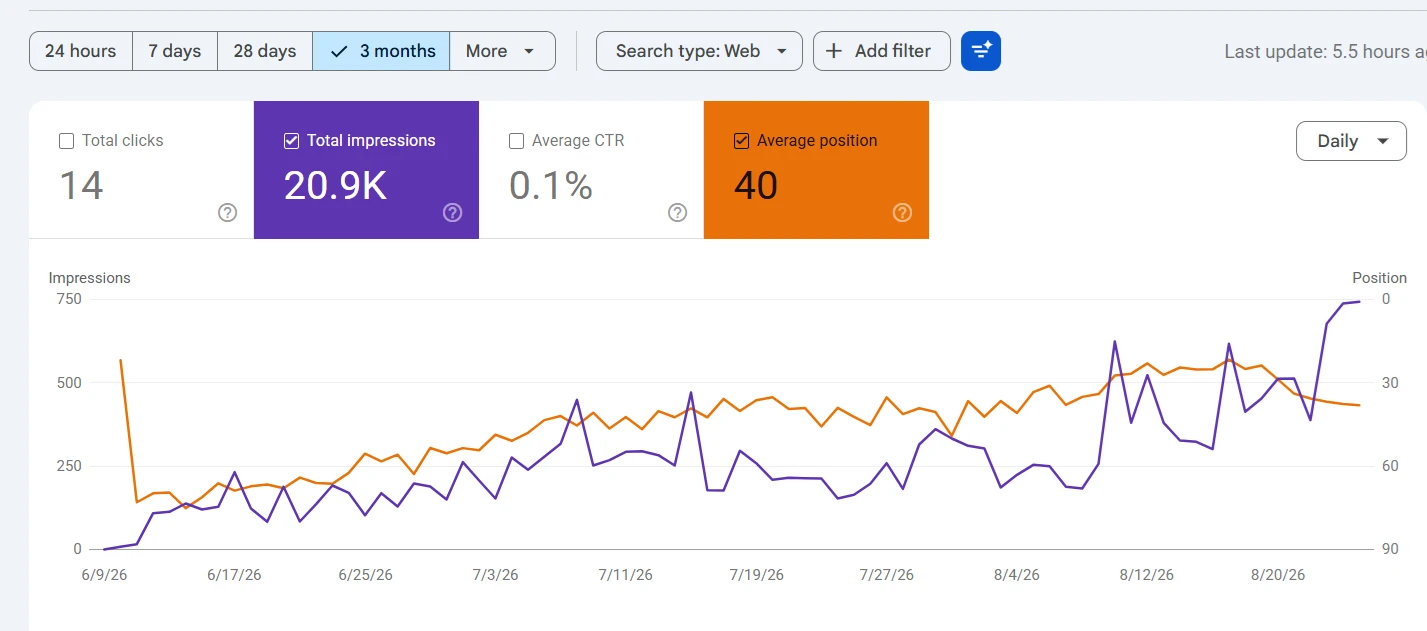
9.61K to 20.9K Impressions, Month Two to Month Three

Newly Launched Roofing Website - Three Month SEO Stats

A brand-new roofing site with no history. Its first two months reached 9.61K impressions at an average position of 49.1. By the end of month three that had more than doubled to 20.9K impressions and the average position had improved to 40. Clicks are still small at 14, which is normal this early: a new domain earns visibility before it earns the top-of-page positions that produce clicks.

20.9KImpressions, from 9.61K
14Clicks, from 7
40Avg. Position, from 49.1
2.2xImpression Growth

See the full project

roofing website Search Console three month impressions and position growth

428K to 640K Impressions, Year on Year

Two Years of Organic Growth in Search Console

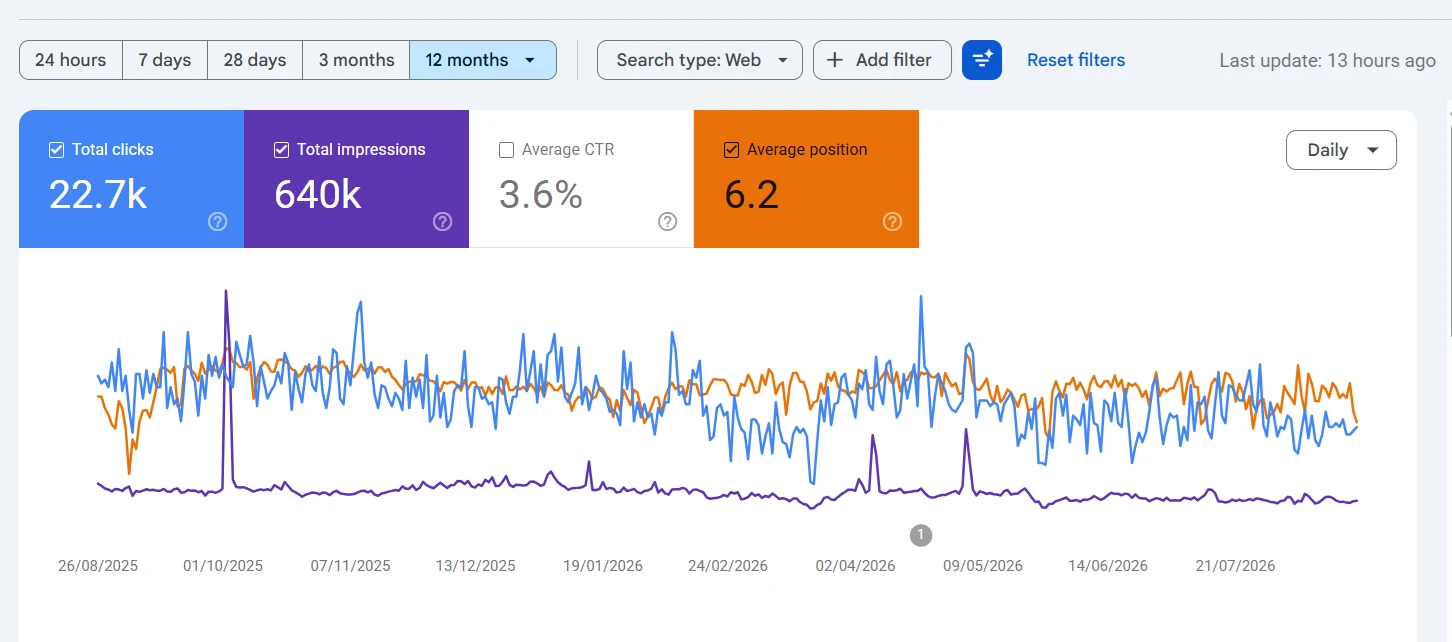
Two consecutive twelve-month windows for an online store. The first closed at 428K impressions and an average position of 9.8. The second reached 640K impressions with average position improved to 6.2, moving the catalogue from the foot of page one to the middle of it across a broad set of queries.

640KImpressions, from 428K
22.7KClicks, from 20.8K
6.2Avg. Position, from 9.8
+50%Impression Growth

See the full project

Search Console twelve month clicks and impressions growth

Every Store Metric Up ~22% in 30 Days

E-commerce Store, 30-Day Analytics Snapshot

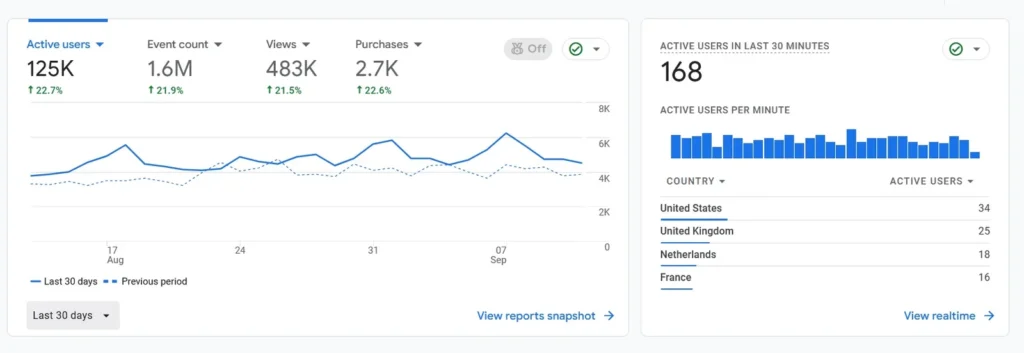
A 30-day window for an online store selling into the US, UK, Netherlands and France. Active users, product views and completed purchases all rose by roughly a fifth against the previous period, so the extra traffic converted rather than just inflating sessions.

125KActive Users
483KProduct Views
2.7KPurchases
+22.6%Purchase Growth

See the full project

Google Analytics 30 day ecommerce users views and purchases

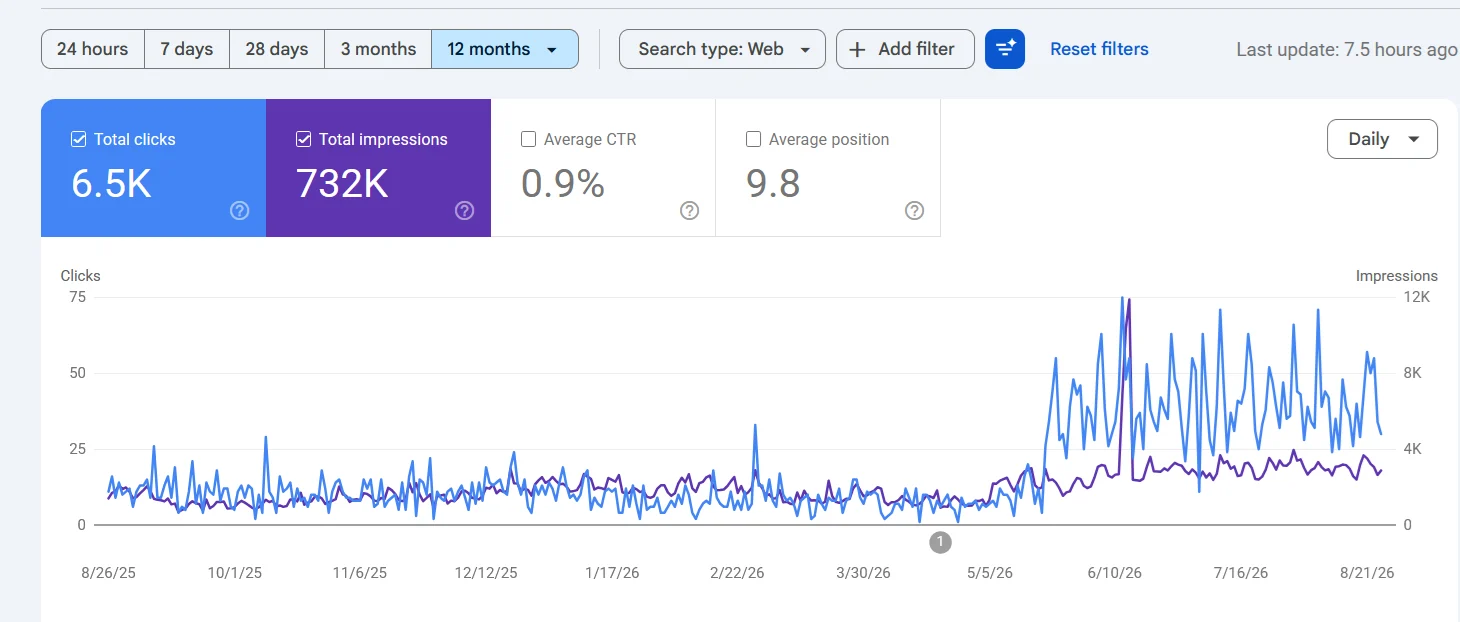
Flat for Nine Months, Then 732K Impressions

Topical Coverage Build for a Local Restaurant

Twelve months of Search Console for a single-location pizzeria. The first nine months sit flat: the site was there, it just did not cover enough of what people were searching for. Once the topical build landed in late May the impression line steps up and stays up, closing the year at 732K impressions and 6.5K clicks. Nothing about the business changed. The coverage did.

732KImpressions, 12 Months
6.5KClicks
9.8Avg. Position
Late MayWhere It Turns

See the full project

Search Console twelve month impressions step change after a topical coverage build

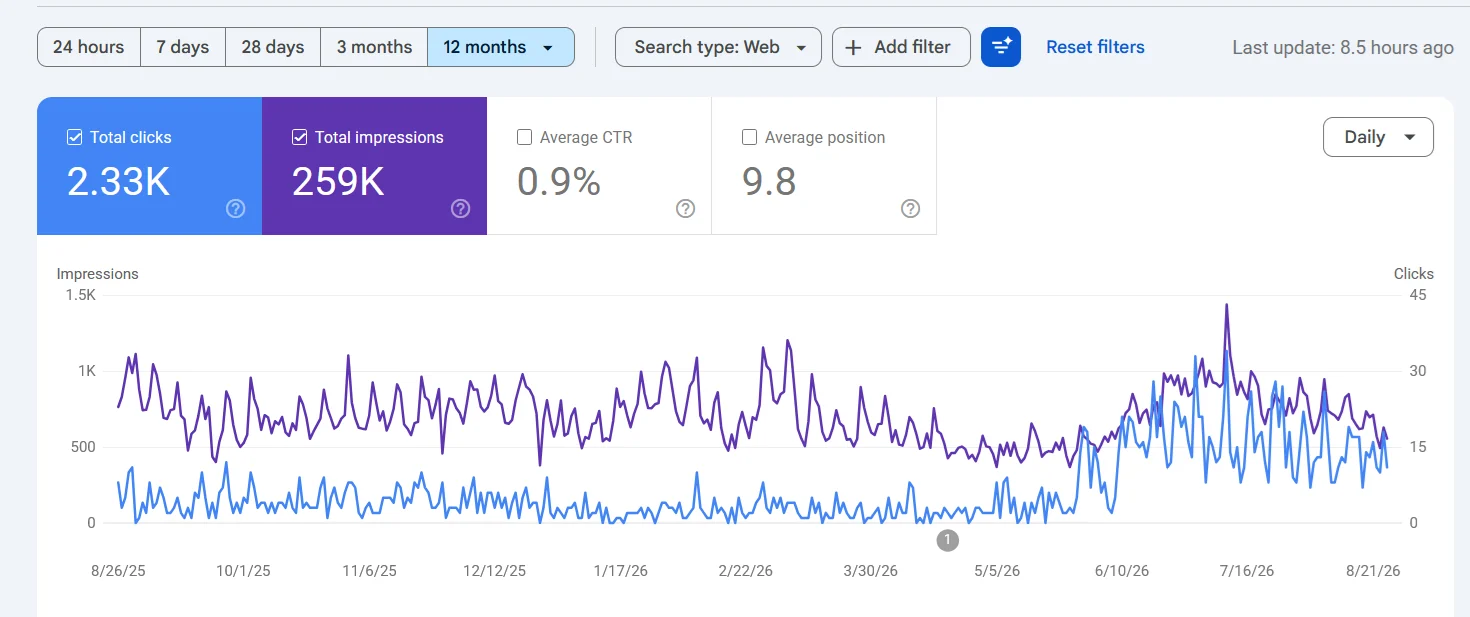
Same Reach, More Than Double the Click-Through

A Restaurant That Ranked and Was Not Clicked

This site was already on page one and taking 64,923 impressions a quarter for 251 clicks, a click-through rate of 0.39%. The rankings were fine. The search snippets were not: 61 pages had no meta description and 62 had titles too long to survive the results page. Fixing what searchers actually see lifted the twelve-month average to 0.9% on the same impression base.

0.9%CTR, from 0.39%
2.33KClicks, 12 Months
259KImpressions
9.8Avg. Position

See the full project

Search Console twelve months with flat impressions and rising clicks

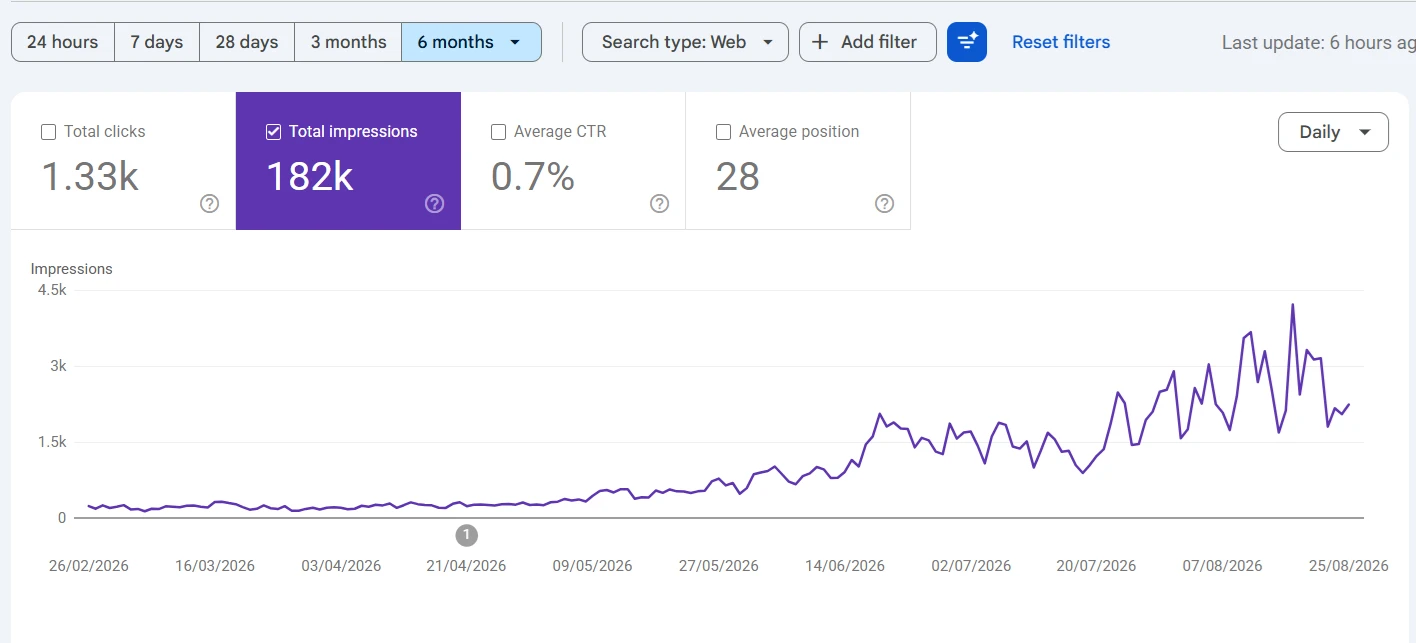
11.1K to 182K Impressions in a Year

Local SEO Build, Two Six-Month Windows Compared

A local cleaning business starting from near-zero visibility. The first six months moved it to 11.1K impressions at an average position of 46.5. The six months after that took it to 182K impressions and position 28. Click-through fell from 4.2% to 0.7% along the way, which is what happens when a site starts surfacing for many more queries before it ranks high on them: the reach arrives first, the positions follow.

182KImpressions, from 11.1K
1.33KClicks, from 471
28Avg. Position, from 46.5
16xImpression Growth

See the full project

Search Console six month impressions growth for a local cleaning business

What changes when your store SEO is built around how collectors actually search

Collector queries are unusually specific and unusually commercial. Someone typing a set number with the word “lights” has already decided to buy; they are choosing where. A store that has a page for that exact combination wins the order.

With a structured eCommerce SEO strategy, you will:

  • Rank for the long-tail buying queries that convert, like set numbers, character names, series titles, scale, and “gift for” patterns
  • Turn collection pages into landing pages instead of dumb filtered lists, so they can rank for the categories buyers actually search
  • Stop wasting crawl budget on infinite filter combinations, so Google spends its visits on pages that can earn money
  • Earn rich results with correct product markup: price, availability, ratings and shipping visible before the click
  • Keep the value in retired and sold-out products rather than deleting the URL and losing every link and ranking attached to it
  • Expand into other countries where the same demand exists, without duplicate-content problems
  • Lift conversion rate with faster pages, clearer stock messaging and fewer steps to checkout

The promise: visibility that shows up in revenue, not just in a rankings report.

Store SEO is not about traffic. It is about being the result a ready buyer chooses over a marketplace, then making the purchase easy once they arrive. On one client store this approach produced 1.9 million active users and 50,000 purchases in twelve months across seven countries.

My Toys & Collectibles Store SEO Framework!

(Built for Product Discovery + Revenue, not Sessions)

I help toys and collectibles retailers rank for the searches that end in an order: set numbers, character and franchise names, series, scale, age range, and gift intent.

My approach is structural. A store does not usually lose because its content is bad. It loses because thousands of near-identical filter URLs are absorbing the crawl, its collection pages are empty lists, and its best products carry the manufacturer’s description word for word.

What you get, end to end:

  • Product and collection page optimisation built for both ranking and conversion
  • Crawl and index control so search engines reach what actually sells
  • Product structured data and feed hygiene for rich results and Shopping
  • Content that supports the catalogue instead of sitting beside it
  • Reporting tied to revenue and purchases, not to keyword counts

How Do My SEO Policies Keep Your Store Penalty-Safe?

Stores get into trouble faster than most sites, because a store can generate thousands of thin pages without anyone writing a word. Filter URLs, tag pages, empty collections and duplicated manufacturer copy all pile up on their own.

My policies follow white-hat, Google-documented standards, and most of the work is subtraction.

My compliance-first guardrails include:

  • No link schemes, paid link networks or manufactured anchor text
  • No doorway collection pages built purely to target a keyword with no stock behind it
  • Duplicate control across variants, so ten colourways do not compete against each other
  • Index discipline, so the pages Google holds are the pages that can convert
  • Product copy written to be genuinely useful to a buyer, not spun from a supplier feed

Result: growth that survives core updates, on a store that does not carry hidden risk.

What SEO Protocols Do I Follow for Toys & Collectibles Stores?

Collectible buying has clear stages. Someone researching a franchise is not the same person typing an exact set number with their card in hand. Your site needs a page for each stage, and they must not compete with one another.

I map your catalogue to a clear taxonomy, then build pages against it.

My structured protocol covers:

  • Full store audit: technical, crawl, on-page, catalogue structure and content
  • Intent mapping across research, comparison, and exact-product searches
  • Entity-based optimisation around franchises, characters, series, scale, materials and compatibility
  • Catalogue segmentation so every collection page has a reason to exist
  • Consolidation of duplicate, cannibalising and orphaned product URLs

How Do I Use Keyword Research to Attract Collectors and Gift Buyers?

Toys and collectibles have two completely different audiences sharing one catalogue. The collector knows exactly what they want and searches by identifier. The gift buyer knows nothing and searches by recipient, age and occasion. Most stores build for neither.

My keyword research method includes:

  • Identifier-led research: set numbers, model codes, character names, series and release years
  • Gift-intent research: “gift for”, age brackets, occasions, budget bands
  • Compatibility and accessory queries, which are often uncontested and highly commercial
  • Marketplace gap analysis: what Amazon and eBay rank for on your products, and where their listings are weak enough to beat
  • Seasonality mapping, so the pages that matter at Christmas are built and indexed by autumn, not in December

Outcome: you show up for searches that end in an order, not searches that end in a bounce.

How Do I Make Your Product Pages Rank and Convert?

The product page is where the money is, and it is usually the weakest page on the store. Most carry the manufacturer’s description, which every competitor also carries, and offer search engines nothing to prefer them for.

Product page work includes:

  • Original descriptions that answer what a buyer actually asks: what is in the box, what it fits, what it does not, dimensions, age suitability, condition
  • Titles and meta descriptions built for click-through against marketplace listings
  • Variant handling so sizes and colourways consolidate correctly instead of splitting signals
  • Image SEO: real photography, descriptive filenames, alt text, and compression that does not ruin detail collectors care about
  • Trust and conversion elements above the fold: stock status, delivery, returns, authenticity

How Do I Fix Your Category and Collection Pages?

Collection pages have the highest ranking potential on any store and are almost always the most neglected. A collection page with a heading and a grid of products gives a search engine nothing to rank. It is a list, not a page.

Collection page work includes:

  • Real content on the pages that target real demand, placed so it never pushes products down
  • A collection structure that mirrors how buyers search, not how your supplier organises stock
  • Internal linking from collections down into the products that deserve the visibility
  • Pagination handled so page two onward stays crawlable without competing with page one
  • Empty and near-empty collections removed or merged before they drag quality down

How Do I Stop Faceted Navigation Burning Your Crawl Budget?

This is the single most expensive technical problem in eCommerce SEO and almost nobody sees it happening. Six filters with five options each can generate tens of thousands of crawlable URLs from one collection. Search engines spend their visits there instead of on your products.

The symptom looks like a content problem: new products take weeks to appear in search. The cause is that the crawler never got that far.

Faceted navigation work includes:

  • A full crawl to measure how many URLs your filters are actually generating
  • A rule for every facet: index it, canonicalise it, or block it
  • Promoting the handful of filter combinations that have genuine search demand into real landing pages
  • Blocking sort orders, session parameters and infinite combinations at the source
  • Log-file and Search Console checks to confirm crawl budget moved to the pages that sell

How Does My Off-Page Strategy Build Your Store's Authority?

You are competing against domains with enormous authority. You will not beat them on raw strength, so the links you earn have to be relevant enough to outweigh that on specific topics.

Off-page strategy includes:

  • Editorial placements in the enthusiast press, fan communities and hobby publications that actually cover your category
  • Relevance over volume: one link from a respected collector site beats fifty generic ones
  • Brand mention building, so your store is named in the conversations buyers already read
  • Creator and community relationships, where this category is unusually strong
  • Reputation work across the platforms buyers check before ordering from an independent

How Do I Use Technical SEO to Improve Your Store's Performance?

Stores fail technically in ways that content sites never do: enormous URL counts, heavy third-party scripts, image-dense pages, and platform behaviour you cannot fully control.

Technical SEO work includes:

  • Crawl and index auditing across the whole catalogue, not a sample
  • Core Web Vitals on the templates that matter: collection, product and cart
  • Redirect and status code cleanup, especially around discontinued stock
  • XML sitemaps split by type so indexing problems are visible instead of hidden
  • JavaScript rendering checks, since many storefronts hide products from crawlers by accident

How Can Content Marketing Grow a Toys & Collectibles Store?

Content only pays on a store when it connects to the catalogue. A blog that ranks and sends everyone to a dead end is a cost, not an asset.

This category is one of the best in retail for content, because the audience is genuinely passionate and researches heavily before buying.

Content deliverables include:

  • Buying guides that map to real collections and link into them
  • Comparison and compatibility content, which captures buyers at the decision point
  • Series, franchise and release-history hubs that build topical authority
  • Gift-intent content built and indexed well ahead of each season
  • Internal linking discipline: every article carries the reader toward a product

What Structured Data Do I Implement for Your Products?

Product markup decides how your listing looks in the results. Price, availability and review stars showing before the click change click-through rate materially, and on a store that is revenue.

Structured data work includes:

  • Product, Offer and AggregateRating markup that matches what is actually on the page
  • Availability and price kept accurate automatically, so markup never contradicts the page
  • Shipping and returns detail where it qualifies for enhanced display
  • Breadcrumb markup so the result shows your category path rather than a raw URL
  • Merchant feed alignment, so organic and Shopping tell the same story

How Do I Handle Out-of-Stock, Retired and Seasonal Products?

This category retires stock permanently. Sets are discontinued, exclusives sell out and never return. Most stores delete the page, and with it every link, every ranking and every bit of history that URL had earned.

Retired products often hold the strongest links on the entire store, because that is what collectors wrote about.

Lifecycle work includes:

  • A policy per state: temporarily out of stock, discontinued, seasonal, replaced
  • Keeping temporarily out-of-stock pages live and indexed with honest availability markup
  • Redirecting genuinely retired products to the closest live equivalent, never to the homepage
  • Turning high-authority retired pages into archive or reference pages that keep earning links
  • Seasonal collections kept live year-round so they hold their rankings for next season

How Do I Track and Measure SEO Success for an Online Store?

On a store there is no excuse for reporting rankings. Every visit can be traced to revenue, so that is what I report.

Reporting and measurement includes:

  • Organic revenue, purchases and conversion rate, segmented by landing page type
  • Product versus collection versus content performance, so you can see what is actually earning
  • Indexation health: how much of your catalogue is genuinely available to search engines
  • Crawl efficiency, so you can see budget moving toward pages that sell
  • A monthly action plan driven by the data, not a dashboard with no decision attached

How Do I Take Your Store Into International Markets?

Collector demand does not respect borders. The same set searched in Manchester is searched in Munich and Minneapolis, usually with far less competition in the non-English markets.

This is often the largest untapped opportunity on an established store, and the one most often implemented wrongly.

International work includes:

  • Market selection based on real demand and on what you can actually ship
  • Hreflang implemented correctly across a large catalogue, which is where most stores fail
  • Currency, tax and delivery expectations handled so the listing does not mislead
  • Localised collection and product content, not machine-translated duplicates
  • Per-market measurement, so you know which countries deserve more investment

On one client store this took organic reach to seven countries above 3,000 monthly users each, with the United States, United Kingdom and Germany leading.

How Do Reviews and Customer Photos Affect Your Store's SEO?

Buying a collectible from an independent store is a trust decision. Reviews carry that decision, and they feed rich results at the same time.

Review strategy includes:

  • Post-purchase review requests timed to when the item actually arrived
  • Product-level reviews, not just store-level, so individual pages qualify for rating display
  • Customer photography, which in this category is genuinely persuasive and adds unique content
  • Review markup that matches what is visible on the page
  • Response handling that protects the store’s reputation where buyers check it

Why Choose My SEO Services for Your Toys & Collectibles Store?

Store SEO is not content SEO with products attached. It is catalogue architecture, crawl economics, feed accuracy and conversion, on a site that changes every day as stock moves.

What makes my approach different:

  • Structure first: fix what stops search engines reaching your products before writing anything
  • Revenue-first reporting, because a store can measure it and should
  • Marketplace-aware strategy: I target where Amazon and eBay are beatable, not where they are not
  • Lifecycle discipline, so the equity in retired products is never thrown away
  • Compliance-first execution that holds through core updates

Locations I Serve and Cover Globally for eCommerce SEO Services!

Expanding my expertise across the globe, I proudly serve and cover locations worldwide to meet diverse needs.

Nizam Ud Deen - SEO Expert

Why Choose me for Toys & Collectibles Store SEO?

What sets me apart is that I have run this exact work on a live international store rather than read about it.

My Expertise: I combine catalogue-level technical SEO with the commercial side of retail, so the work is judged on orders rather than on impressions.

Proven Success: On Game of Bricks, an international store selling lighting kits for display sets, the twelve-month figures are 1.9 million active users, 25 million events and 50,000 purchases, with organic reach across seven countries. The full data is on the Game of Bricks case study.

Comprehensive Services: From crawl and index control through product and collection optimisation, structured data, feeds, content and international expansion, I handle the whole store rather than one layer of it.

Choose me if you want a store that sells more, not a report that says the rankings improved.

Hire the Best eCommerce SEO Expert!

Whether you sell on Shopify, WooCommerce, Magento, BigCommerce or a custom storefront, I cover every layer of store SEO with expertise and precision. Your ultimate choice for hiring the best eCommerce SEO expert.

WordPress SEO

WooCommerce SEO

Weebly SEO

SquareSpace SEO

Local SEO

Wix SEO

Shopify SEO

SAS SEO

What's Included in my Toys & Collectibles Store SEO Services?

My SEO services cover every element that decides whether a store gets found and whether the visit turns into an order.

On-Page SEO

Improving your website’s content, headlines, images, and structure to rank higher and engage users effectively.

Technical SEO

Fixing backend elements like site speed, mobile-friendliness, secure connections, and crawl errors to enhance performance.

Off-Page SEO

Building trust and authority by earning quality backlinks, social mentions, and external brand mentions.

SEO Audit

A detailed review of your website to identify technical, on-page, and off-page SEO issues and create an improvement plan.

Local SEO

Optimizing your online presence for local searches, including Google Maps and directories, to attract nearby customers.

GBP Reinstatement

Resolving suspensions and optimizing your Google Business Profile to regain local search visibility.

Keyword Research

Discovering high-value search terms your audience uses and aligning them with your content for better rankings.

Competitor Analysis

Evaluating your competitors’ keywords, backlinks, and strategies to uncover opportunities for your growth.

Content Writing

Creating compelling, SEO-optimized blog posts, product descriptions, and web pages to attract and convert visitors.

Penalty Removal

Diagnosing and resolving issues like bad backlinks or duplicate content to recover from search engine penalties.

E-Commerce SEO

Optimizing product listings, category pages, and site navigation to drive more traffic and boost online sales.

YouTube SEO

Enhancing video titles, descriptions, tags, and thumbnails to rank higher on YouTube and in Google search results.


What My Clients Are Saying About Me!

Posted on Google Google
umair Rauf profile picture
umair Rauf
Google star 1Google star 2Google star 3Google star 4Google star 5Trustindex verifies that the original source of the review is Google.
A dedicated SEO expert in the field of digital marketing. Giving his best and inspiring us by his results. It is proud moment for us that sir nizam shb is Nominated in top 20 SEO experts in 2024. A great personality.
Posted on Google Google
Kashif Hussain profile picture
Kashif Hussain
Google star 1Google star 2Google star 3Google star 4Google star 5Trustindex verifies that the original source of the review is Google.
I’ve had the pleasure of witnessing the incredible work of Nizam. With several years of experience in SEO, he consistently delivers exceptional results and has a deep understanding of how to help businesses grow online. His expertise in improving rankings and driving targeted traffic is truly unmatched. Highly recommended if you’re looking for reliable, result-driven SEO services in Pakistan!
Posted on Google Google
Ali Rizvi profile picture
Ali Rizvi
Google star 1Google star 2Google star 3Google star 4Google star 5Trustindex verifies that the original source of the review is Google.
Highly professional, excellent work ethics, delivered on time, good communication skills and understands the tasks well. Highly recommended
Posted on Google Google
muzammil rao profile picture
muzammil rao
Google star 1Google star 2Google star 3Google star 4Google star 5Trustindex verifies that the original source of the review is Google.
Amazing experience for Local SEO service

am i bragging?

Why You Choose NizamUdDin for SEO Consultancy?

Proven Results

You will experience tangible expansion in your rankings, traffic, and sales.

Responsive 24/7

Feel free to reach out at any time for prompt and personalized assistance, all at no cost.

Accountable 100%

There will be no uncertainty about the actions taken, the reasons behind them, or the subsequent steps in progress.

Trusted By

Our Clients

We have helped businesses across industries build their digital presence and grow their revenue.

House DesignerInterior design and home styling specialists. We helped them dominate local search for home design services.
Office DesignerCommercial workspace design. Our SEO strategy put them in the top 3 for office fit-out searches.
Game of BricksLED lighting kits and accessories. We drove a 3x increase in organic traffic through targeted product SEO.
Care N TidyProfessional cleaning services. Our local SEO work boosted their online visibility and lead generation.
Bella PizzahhLocal restaurant chain. We helped them capture local food delivery searches and grow their customer base.
Pronto PizzaFast-casual dining brand. Our local SEO work put them at the top of near-me pizza results.
HMB PotteryHandmade Multani blue pottery. We built the online store that takes their craft beyond the local market.

Frequently Asked Questions

Most frequent questions and answers

What is SEO for a toys and collectibles store?

It is the work that makes your own product and collection pages the result a buyer chooses, instead of the marketplace listing selling the same item. For this category that means building for how collectors search, by set number, character, series, scale and release year, and for how gift buyers search, by recipient, age and occasion.

A complete strategy usually combines:

  • Product page SEO: original descriptions, correct variants, real photography, structured data
  • Collection page SEO: turning filtered lists into pages that can actually rank
  • Technical and crawl control: faceted navigation, indexation, speed, rendering
  • Lifecycle handling: out-of-stock, discontinued and seasonal products
  • Trust signals: reviews, customer photos, clear delivery and returns

Will SEO actually increase sales, or only traffic?

On a store you can prove the difference, which is why I report revenue rather than rankings. The traffic that matters is the traffic arriving on a page that can take an order.

To increase orders rather than sessions, the work focuses on:

  • Targeting buying-stage searches, not just category-level interest
  • Landing buyers on product and collection pages instead of blog posts
  • Click-through improvement through titles, meta descriptions and rich results
  • Conversion work on the pages the traffic actually lands on
  • Removing friction: page speed, honest stock messaging, delivery clarity

How do I compete with Amazon, eBay and the big retailers?

Not on domain strength, and not on their terms. You compete on relevance and depth, which is where a marketplace listing is genuinely weak.

A marketplace holds millions of products and treats yours as a row of data. You can build a page that answers what the buyer actually wants to know. Search engines can tell the difference when the page is built to be found.

Practically, that means:

  • Going after specific identifier and compatibility searches rather than broad head terms
  • Depth on your product pages that a feed-generated listing cannot match
  • Collection pages built around how enthusiasts group things, which marketplaces do badly
  • Earning links from the enthusiast press, where an independent can outrank a giant
  • Trust signals that answer the real question: why buy here rather than there

Do you write product and collection page content?

Yes, and on most stores it is the highest-value writing available, because so few competitors do it. Copying the manufacturer’s description means offering a search engine nothing to prefer you for.

Typical deliverables include:

  • Original product descriptions covering contents, fit, compatibility, dimensions, age suitability and condition
  • Collection page copy that adds genuine context without pushing the products down the page
  • Buying guides and comparisons that link into the catalogue
  • FAQ content on the questions that stop people ordering

Should I worry about duplicate manufacturer descriptions?

Yes, and it is one of the most common reasons an independent store cannot outrank a marketplace for its own stock. If your page carries the same supplier text as two hundred other retailers, there is no reason for a search engine to pick yours.

How I handle it:

  • Prioritise by revenue: rewrite the products that can actually move the numbers first
  • Add what the supplier feed never contains: what fits it, what it does not, real measurements, condition and packaging detail
  • Use your own photography, which is unique content in its own right
  • Let customer reviews and photos build unique content on the page over time

How does site speed affect an online store?

More than on almost any other kind of site, because the cost of a slow page is a lost order, not a lost pageview. Stores are also the slowest sites on the web by nature: heavy imagery, review widgets, chat, analytics and marketing tags all stacked on the same template.

High-impact improvements usually involve:

  • Image delivery, since a collectibles store lives on photography that must stay detailed
  • Auditing third-party scripts, which are usually the real cause
  • Optimising the collection and product templates specifically, since that is where buyers land
  • Layout stability, so nothing shifts under the buyer’s thumb as they tap add to basket

How long does eCommerce SEO take to work?

Store SEO often shows earlier movement than other kinds, because much of the early work is unblocking pages that already exist rather than creating new ones. Fixing crawl waste or indexation can surface products within weeks. Competitive category rankings and international expansion build over three to six months.

What affects the timeline most:

  • How much of your catalogue is currently indexed at all
  • The scale of the crawl problem your filters are creating
  • How much of your product copy is duplicated from suppliers
  • Your store’s existing authority against the marketplaces you are competing with
  • Whether your category has seasonal peaks you need to be ready for in advance

How do I measure the success of an eCommerce SEO campaign?

By revenue. A store can attribute organic search to orders, so there is no reason to settle for a rankings report.

Typical KPIs include:

  • Organic revenue and purchases, split by landing page type
  • Organic conversion rate, which tells you whether the traffic is the right traffic
  • Revenue per session, the number that exposes traffic growth with no commercial value
  • Catalogue indexation: how much of what you sell is actually findable
  • Rich result and Shopping visibility on your highest-margin products

What SEO strategies will you use for my store?

The order depends on the audit, but the sequence is almost always structure first, then pages, then expansion. Writing content on a store that search engines cannot crawl properly is wasted effort.

Core strategies usually include:

  • Crawl and index control, starting with faceted navigation
  • Collection page rebuilds, usually the fastest meaningful win available
  • Product page optimisation prioritised by margin and demand
  • Structured data and feed accuracy for rich results and Shopping
  • Content that supports the catalogue and links into it
  • International expansion once the domestic store is performing

What makes your SEO different for toys and collectibles?

This category has search behaviour almost no other retail category has. Buyers search by identifiers, which is unusually precise; they care about exclusivity and retirement, which makes product lifecycle a ranking issue rather than an admin task; and demand spikes hard around releases and gifting seasons.

The difference comes from:

  • Building for identifier-led search, which generic eCommerce SEO ignores
  • Treating retired products as assets to preserve rather than pages to delete
  • Planning seasonal pages far enough ahead that they are indexed before the demand arrives
  • Working the enthusiast press and community, where this category punches far above its weight

Can you help with Google Merchant Center and Shopping feeds?

Yes, and it matters more than most store owners expect, because organic and Shopping draw on much of the same data. A feed that disagrees with the page causes problems in both.

Feed work typically includes:

  • Fixing disapprovals and warnings that are suppressing products entirely
  • Aligning titles and attributes with how buyers actually search
  • Keeping price and availability consistent between feed, page and structured data
  • Correct identifiers, so products are matched to the right catalogue entries
  • Using Shopping data to find organic opportunities, since it shows what converts

How much does eCommerce SEO cost?

It depends on catalogue size far more than on anything else. A store with three hundred products and a store with thirty thousand are different pieces of work even if the strategy is the same.

Pricing is usually influenced by:

  • Catalogue size and how much product copy needs rewriting
  • Platform and how much control you have over URLs, templates and rendering
  • The scale of the technical problem, especially crawl waste
  • How many markets and languages you want to reach
  • Competitive intensity in your niche and how entrenched the marketplaces are

See my pricing for the standard packages.

Want SEO Consultancy for your project?

If you feel that you are lost in somewhere middle, I am here to help you with this.

eCommerce Specialisms I Cover

eCommerce SEO is what I do best, and I have the store data to prove it.